30% of local drownings happen in South King County
Published 4:05 pm Monday, July 21, 2025



July, August, and September are when most people hit the water to cool off — but it also is when the most people drown in King County.
According to Public Health — Seattle & King County data, out of more than 280 drownings since 2013, roughly 40% occurred in the later summer months.
Additionally, roughly 54% of these deaths happen in open bodies of water, where temperatures can range between 50 and 60 degrees; hypothermia can set in between 30 minutes to an hour at these temperatures.
“The water in the Pacific Northwest remains very cold, even on hot days, and even strong swimmers can experience their muscles freezing up within just moments of entering the water,” King County Public Health spokesperson Kate Cole said. “Rivers, in particular, can be very dangerous – they remain quite cold, often have deceptively strong currents, and can have hidden hazards, such as branches, that change from year to year.”
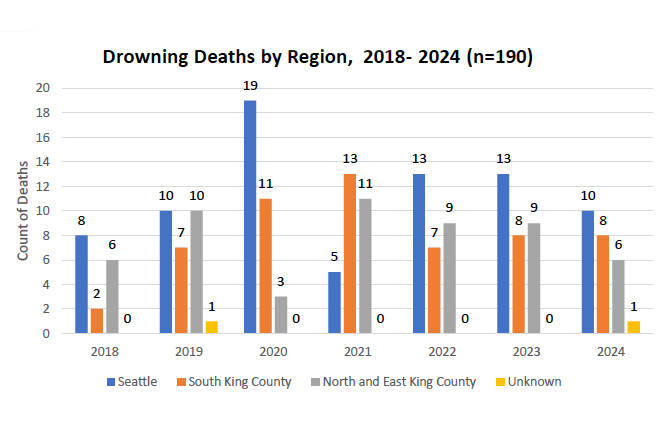
Over the last seven years, roughly 30% of all King County drownings were reported in South King County, which includes Maple Valley, Covington, Renton, Kent, Federal Way, Burien, Black Diamond, and Enumclaw.
Drownings have become more common in recent years.
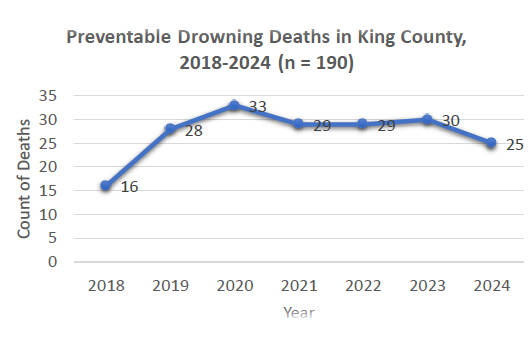
After a high of 22 drownings in 2016, deaths dropped to 17 the following year and 16 in 2018.
However, deaths spiked in 2019 with 28 drownings, and ticked up again to 33 in 2020.
Drownings averaged about 30 per year for the next three years, and dipped to 25 deaths in 2024.
Cole said the increase in drownings are a result of several factors, including warmer springs when the water is even colder than in the summer, a nationwide shortage of lifeguards, and inequitable access to pools and swim lessons.
Lake Washington has had the most people drown over the last seven years, with a total of 27, or about 14% of all drownings (or nearly 27% of only open water drownings).
More locally, the Green River has taken ten lives between 2018 and 2024, which is 10% of all open water drownings.
More than 60% of the total drownings since 2018 involved alcohol or another substance.
While cold water can be a danger to swimmers who aren’t inebriated, it can be extra dangerous for swimmers who have been drinking or taking other substances.
Entering a cold body of water (60 degrees or less) can cause an involuntary “gasp reflex” even when sober; impairment may increase the risk of inhaling water when submerged, experts say.
Cold water can also cause caloric labyrinthitis — an inner ear condition that causes disorientation in the water, which can be exacerbated by alcohol and cause the swimmer to no longer which way is up or down.
WATER SAFETY TIPS
Experts at the King County Sheriff’s Office, Public Health – Seattle & King County, and the Department of Natural Resources and Parks recommend:Wear a life jacket – discounts and loaners are available
Do not consume alcohol and drugs when around water
Remember that lakes, rivers and the ocean can remain dangerously cold even when the air temperature is warm
Take extreme caution around rivers. If you do choose to enter a river, always tell someone where you plan to enter and exit before you leave home
When children are swimming or playing near the water, designate an adult to watch and stay nearby at all times
Swim at public pools monitored by lifeguards and enroll in swim lessons. More information about public pools, including free and low-cost swim lessons, from Seattle Parks and Recreation and King County’s Weyerhaeuser Aquatic Center