Editor’s note: We’re spending time this summer focusing on the great outdoors: namely, some of the noteworthy campgrounds and trails found in the Evergreen State. Most of the campgrounds will be within a reasonable driving distance from the Plateau and the same goes for trails. This series will extend into August and, hopefully, provide encouragement to get on the road and enjoy life outside – whether pitching a tent or “glamping” in a luxurious motor home, whether walking a paved pathway or mountain trail.
This series began with a look at Dosewallips State Park and Week 2 told of a local, unpaved section of the Foothills Trail. Week 3 featured a report on Manchester State Park, followed by a hike at the Little Mashel Falls trail in Eatonville, a camping report from Steamboat Rock State Park and, last week, a hike along the trails of Federation Forest State Park. Today, it’s back to camping with a visit to Wenatchee Confluence State Park.
All campgrounds and trails were visited recently by the author, his wife and, usually, their two dogs. They aren’t exactly “roughing it” these days, having long ago abandoned a tent for a travel trailer.
Admittedly, Wenatchee Confluence State Park wasn’t high on our bucket list. It’s the anthesis of a remote, woodsy campground and, at 194 acres, it’s not all that large.
But there are a lot of opportunities packed into a relatively small space.
First, about the location: this almost fits the “urban camping” definition, as the state park is accessed by driving into Wenatchee and using city streets. It’s not too tough a bicycle ride to mini-marts and fast-food joints.
But that’s only half the story.
On the other side of the park, campsites are just steps away from the Columbia River. And, through a joint-use agreement with the local PUD, a handful of other recreational opportunities await. Thus, Wenatchee Confluence is really, really family friendly.
So, let’s take a deeper dive into this Chelan County destination.
Camping: The state park is home to 52 full-hookup sites (some pull-through, some back-in), each with a picnic table, along with eight standard sites. Additionally, a group-camp site can accommodate up to 300 people.
The individual campsites are generally flat and easily accessible, but short on privacy. There’s plenty of lawn and a sprinkling of trees.
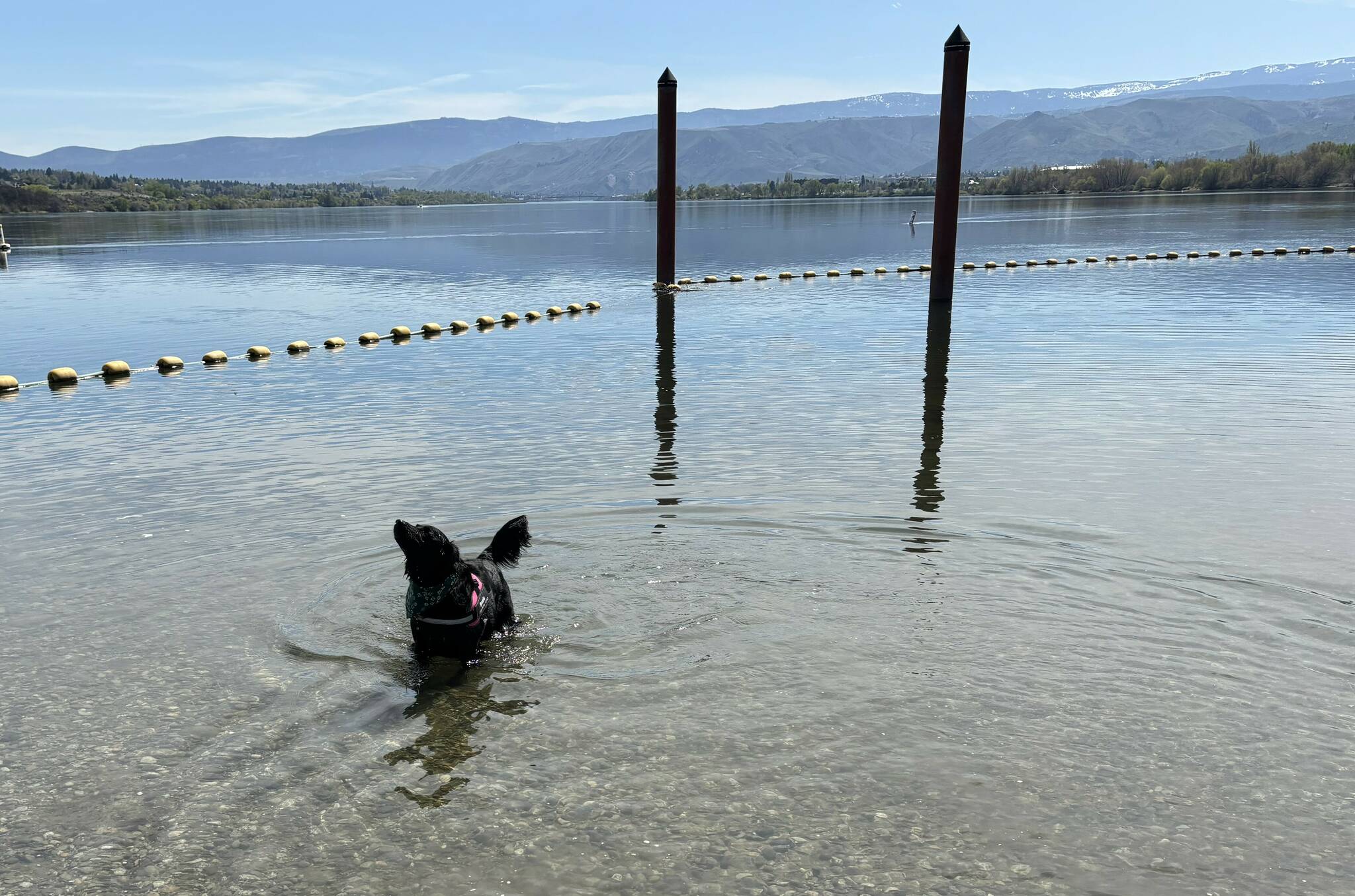
Amenities: The neighboring river includes a good-sized swimming area and sandy beach, surrounded by grassy fields.
A wetland nature preserve offers scenic beauty and abundant bird-watching opportunities.
The river also allows for boating and fishing with an on-site, two-lane boat launch. The park is flat and packed with a basketball court, soccer field, tennis courts, ball fields and volleyball court. For a more passive experience, there are picnic shelters.
Again, this is not necessarily for the “roughing it” crowd.
Longest loop trail: According to Washington State Parks, this park is part of the Apple Capital Loop Trail, the longest loop trail in the state. It’s a 10-mile paved route and designated as mixed-use, meaning it’s home to bicyclists, runners, walkers and skaters. The trail winds through Wenatchee Confluence and several other riverfront parks and crosses two bridges over the Columbia. There’s an option to cycle 5.5 miles to Lincoln Rock State Park and a shorter extension heads into downtown Wenatchee.
Park history: Like most of Washington’s state parks, the land was originally home to indigenous people. Things changed with the 1855 Treaty of Camp Stevens and subsequent federal orders, which saw tribal homelands ceded to the U.S. government.
Later sold to settlers, the land was discovered to be a treasure for apple orchards and other fruits. The regional still proudly boasts of being the Apple Capital of the World.
The area was impacted by the 1932 completion of the Rock Island Dam, the first hydroelectric project on the Columbia River. Some 15miles downstream, the dam’s reservoir flooded much of the region. When the Chelan County Public Utility District sought to add to the dam’s power-producing capabilities, the federal government ordered that the PUD provide for recreational opportunities. With that command, the present campground was created at the confluence of the Columbia and Wenatchee rivers.
In April of 1990, the Washington State Parks and Recreation Commission entered into an agreement with the PUD to manage the park.
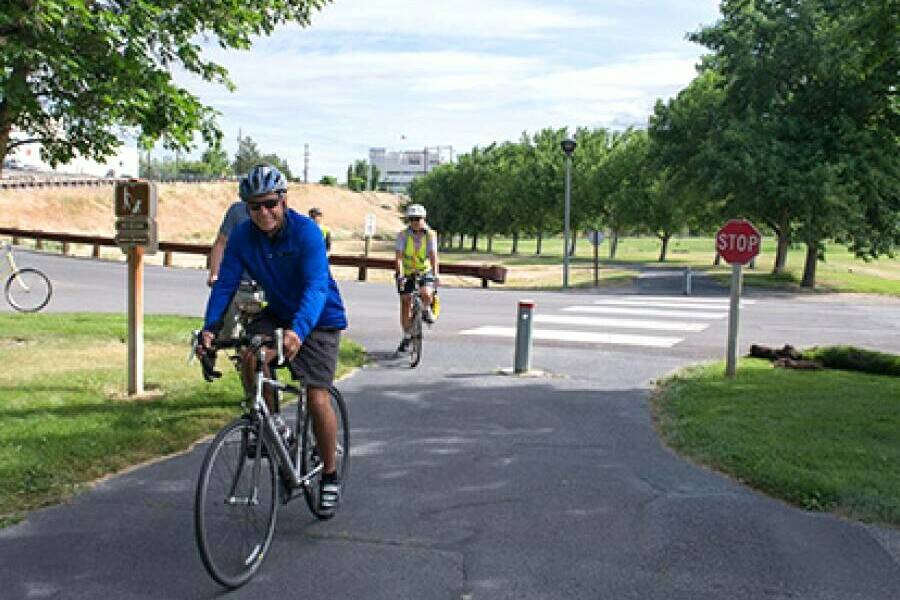
PHOTO BY WASHING STATE PARKS Winding through Confluence State Park is the Apple Capital Loop Trail, a paved path that takes bicyclists, walkers and runners on a 10-mile journey.