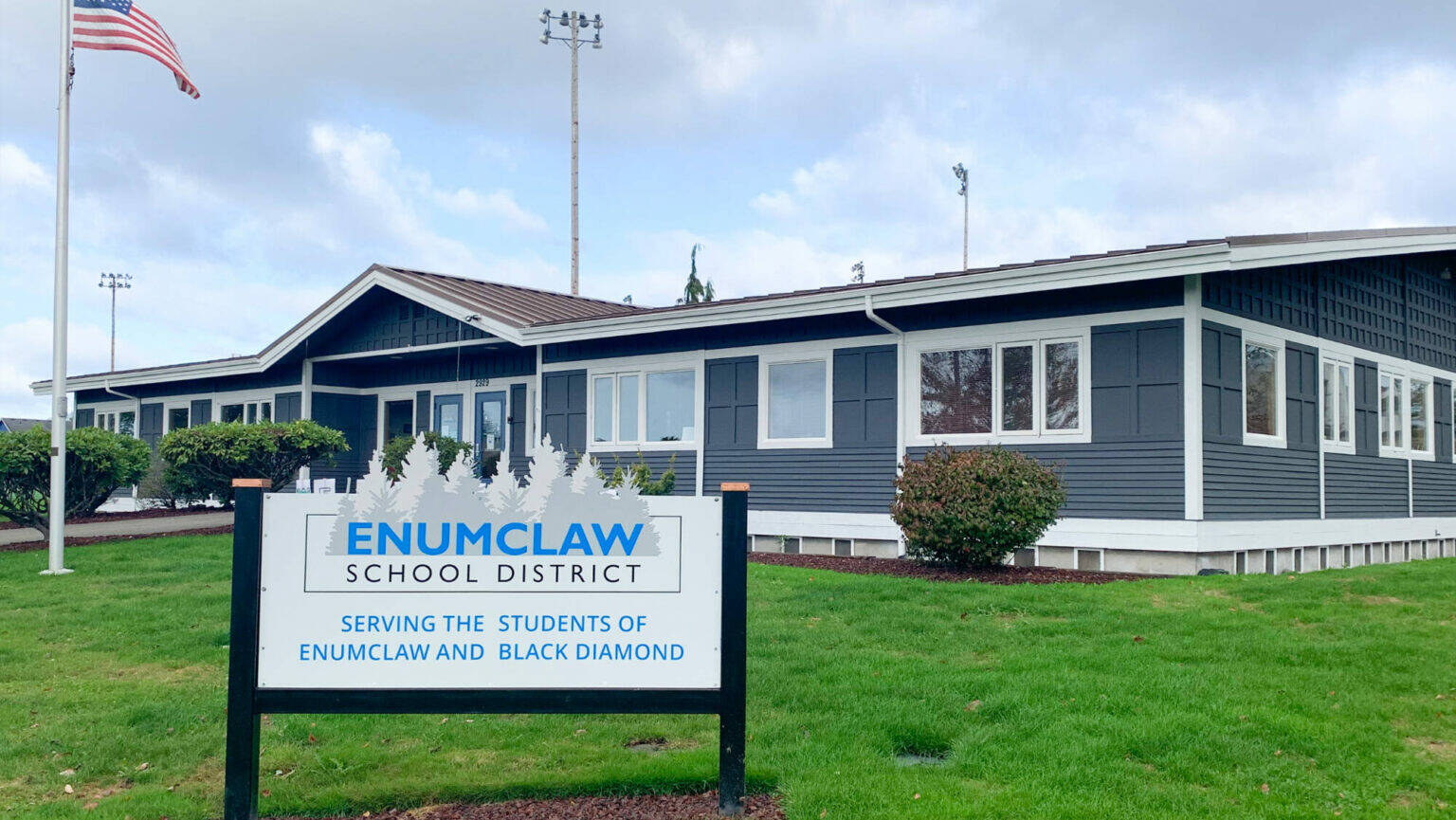
The Enumclaw School District voted on two replacement levy measures on an upcoming election ballot during its Nov. 24 meeting.
The two levies discussed were the Educational Programs and Operations Levy and the Instructional Technology Improvements Levy.
As replacements, these are not new property taxes — and it’s estimated that tax rates will not change between the final collection of the current tax rate and the renewed tax rate, if approved by voters.
Here’s a breakdown of the two proposals, which if approved will be on the Feb. 10, 2026 special election ballot.
EDUCATIONAL PROGRAMS & OPERATIONS
ESD voters have supported the district’s Education Programs & Operations levy since February 1988 (with a blip in February 1998, when the levy received majority support but fell short of the former 60% supermajority requirements).
Formerly called the Maintenance & Operations levy, this property tax is up for renewal every four years. According to the district, it “bridges the gap between what the state provides… and the actual cost of running schools.”
The vast majority of these funds (47%, or more than $5.7 million) used during this budget cycle went to unfunded salaries for all district staff. The next biggest uses are transportation and food services (13%), athletics, activities, and arts (11%), and professional development (10%).
The rest of the funds are sued for safety and security, operational support (like substitutes), student support services, and early learning.
In recent years, this levy revenue has made up around 16% of the district’s total operating budget, making it the far more financially consequential of the two replacement levies being proposed.
The estimated total tax collection in 2027 comes out to roughly $15.4 million of a projected $95 million total budget, “assuming our operating budget increases at the average of recent years,” said ESD Director of Business Kyle Fletcher.
At this time, ESD estimates the levy would be about $1.74 per $1,000 in assessed property value (APV); this is the exact same as the 2026 estimated tax rate, meaning there would be no tax rate increase if the replacement levy is approved by voters.
For a property owner with a $600,000 home, a $1.74 tax rate results in a $1,044 bill in 2027.
The district would collect property taxes at the $1.74 rate through 2030, with estimated revenue coming in at more than $67 million.
TECH LEVY
The replacement Instructional Technology Improvements Levy has helped fund various tech improvement and maintenance projects across the district for the last 13 years.
When voters approved a replacement levy in 2009 and in 2014, funds were used to install smart whiteboards, document cameras, and LCD projectors in 239 classrooms. Tax revenue was also used to purchase nearly 550 laptops that could travel between classrooms when needed.
After voters again re-approved the tech levy in 2020, the district purchased 42 laptop charging carts for every K-5 classroom to have a dedicated set.
Fund were also used to repair or replace two-way radios in every building, providing clearer communication across the district.
The estimated replacement levy rate for collection in 2027 is 28 cents per $1,000 APV.
This is the exact same tax rate for 2026.
For a property owner with a $600,000 home, the that’s a $168 tax bill.
The district would collect property taxes for six years, totaling around $17 million.
FALLING SUPPORT
The Enumclaw School District has had recent trouble gaining support from its communities, either through bonds or levies, in recent years.
Two bonds proposed in 2023: one to build a new school in Enumclaw and Black Diamond, a new performing arts center, and a new football/sports field, failed when 75% of voters rejected the measure; a second, which only proposed building a new school in Enumclaw, also failed with 65% of voters rejecting the measure.
In response, the district proposed a Critical Maintenance levy to address various facility repairs like repairing leaky roofs, replacing decades-old fire panels, and upgrading HCAV systems, among others.
This levy only received 45% of voter support.
At the same time, general support for levies has been falling for about a decade.
Voters approved the formerly-known-as Maintenance & Operations levy in February 2026 with 62.5% of the vote.
Support dipped every four years to 577% in 2010 and 2014, then to 56.6% in 2018 and squeaked by with 51.29% approval in 2022, a difference of less than 200 votes.
Support for the Technology Levy, though has increased or stayed steady — it passed with 53% approval in 2009 (the first time the district ran a tech levy), 57% in 2014, and 56% in 2020.