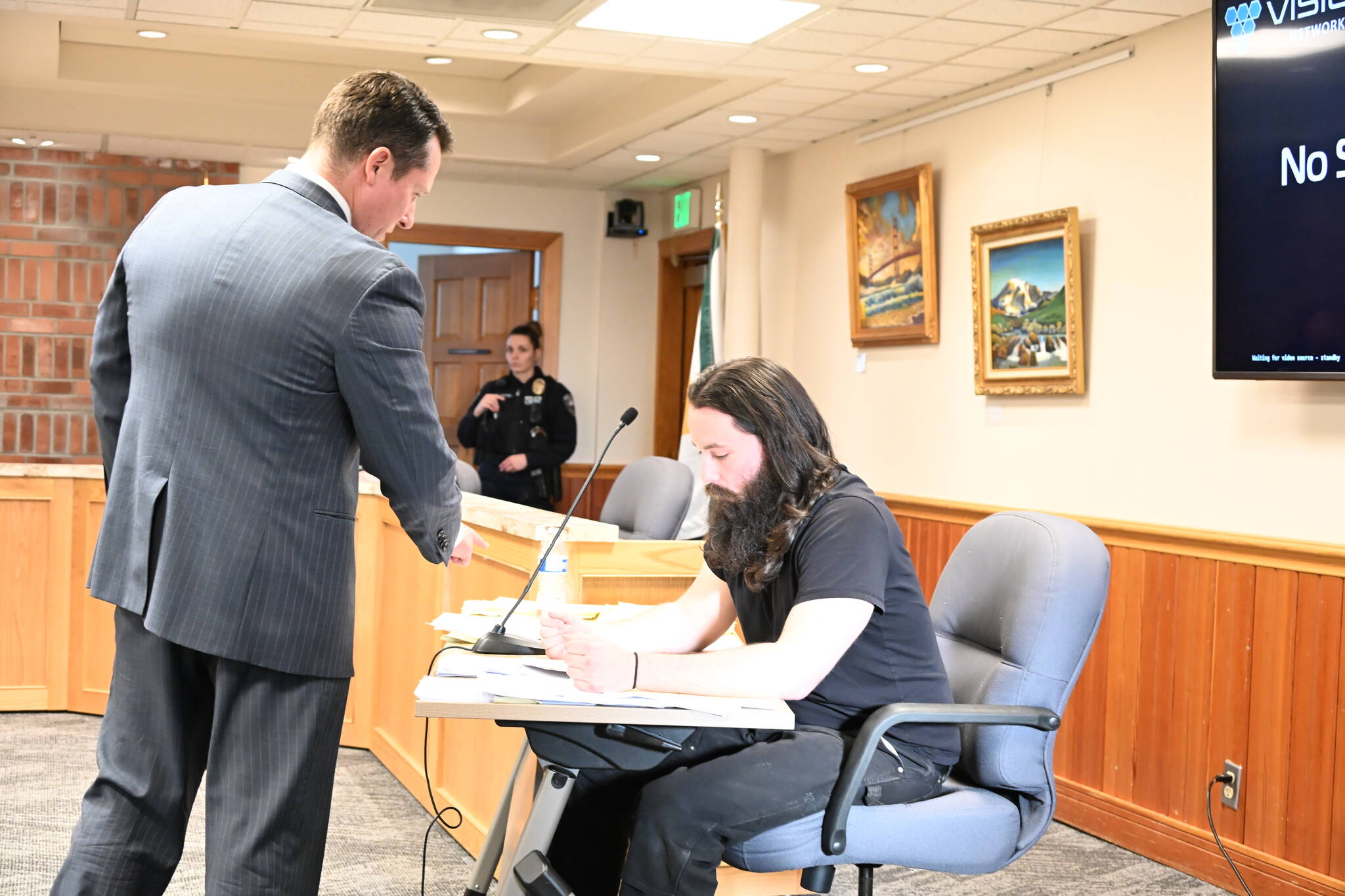
Twenty Enumclaw residents filled the seats of city hall as the court began to select a jury for the first time in at least 16 years.
The trial started Friday, Jan. 9, with jury selection and opening statements. It lasted until Monday, Jan. 12, when the jury came back from deliberation with the verdicts.
As jury selected began, city prosecutor Will Gunderson took up the left side if the room, itching to stand up to speak as is his habit in court; on the right was defendant Robert “Bob” Chevrette III, swiveling in his chair and prepared with papers and notes that took up the whole table.
Chevrette was accused of obstruction of justice, failure to obey a law officer’s orders, and DUI stemming from a Nov. 11, 2025 arrest after a suspected hit-and-run (which he was not charged for, as there was no damage to the other car); the jury found him guilty of the two former charges, but not of driving under the influence.
He was also originally charged with driving with a suspended license in the third degree, but Gunderson and Chevrette agreed to amend the charge to a traffic infraction, which meant this issue would not be brought up during the trial and would be adjudicated without a jury at a different time. Chevrette said he would contest the infraction at that time.
All things considered, these are not major crimes — but the fact that Chevrette declined to take a plea deal of “timed served,” according to sources, for his two months in the Enumclaw jail and instead brought his case to a jury trial, risking additional jail time if he was found guilty, was unusual to say the least; the vast majority of misdemeanor or felony cases (some experts say up to 95%) are resolved via guilty plea in the country, and is further exemplified by Enumclaw’s lack of jury trials for as long as anyone currently working for the city can remember.
But Chevrette was nothing if not confident and completely convinced of his innocence of all charges.
In fact, Chevrette declined to even enter a plea in court, and argued that the judge pro tem overseeing his arraignment was unlawful in doing so for him — an argument that clearly did not sway Judge Samantha Johnson, who only just became Enumclaw’s judge this year.
“I’m still innocent because I acted innocently,” he said in an interview hours prior to the jury completing their deliberations. “… I had no criminal motive. So if they convict me of an act that is… intrinsically innocent, that’s on them. That’s on their conscience, not mine.”
In short, Chevrette’s philosophy on crime appears to be, “no harm, no foul.”
Chevrette said he wanted to fight the charges for two reasons: his aforementioned innocence, and that he believes he’s owed damages for his arrest, as he lost both his job and his car, which he was living in at the time of his arrest.
“You hear [people] b**** about their charges, and then they’ll say they plead guilty. Well, did you do the crime? If they say no, then, well, why did you plead guilty?” he said. “You should fight your charges if you believe you’re innocent. Of you did the crime, then shut up and do the time, But if you really know you’re innocent, you should absolutely fight.”
It’s also for this reason that Chevrette represented himself in court. He said he had poor experiences with private defenders in the past, as he believes they’re more focused on their clients’ “freedom” instead of their “innocence.”
Overall, much of his talking points mirror the “sovereign citizen” movement, although Chevrette said he did not want to be “pigeonholed” into this loose group of anti-government activists.
THE ARREST & TRIAL
The incident started when Chevrette was in line at the McDonald’s in town when he allegedly bumped the car in front of him; the woman, afraid about confronting Chevrette and the other man in the car behind her, opted to call the Enumclaw Police Department instead.
As police began responding to the incident, Sgt. Rich Tison saw a car matching the suspect vehicle description driving away from McDonalds and pursued.
Tison first activated his vehicle’s emergency lights, and when dispatch told him the owner of the vehicle had a suspended license, then activated his sirens. There were two other police vehicles with their lights on as well behind Chevrette’s car.
Despite the lights and sirens, it was a few blocks before Chevrette pulled over.
Tison attempted to contact Chevrette, Chevrette did not roll the window down.
At first, Chevrette did not shut off his car when asked, but then complied when ordered; he did not provide his ID or driver’s license when ordered, however, and shortly after, drove away from the scene.
It appeared EPD officers anticipated this, as one had placed a stop stick under Chevrette’s wheel before the he drove off, popping his tire when he did so.
Despite this, Chevrette continued to drive away at the speed limit, and police officers pursuing sans police lights. Given the apparent lack of attempting to elude officers, Tison told the jury that he didn’t really consider this a pursuit.
Eventually, the flat tire started to flop around and Chevrette pulled over; officers then turned their lights back on to approach the vehicle and ordered Chevrette out.
Chevrette left his vehicle and was arrested without incident.
When he was arrested, officers found a small, empty bottle of alcohol in the car.
Chevrette refuted the city’s allegations: he denied knowing that he hit the car in the drive-through line; contended that he did not fail to obey Tison’s orders and, in fact, attempted to “aid” his investigation by asking — through the aforementioned closed window — why he was being arrested; and argued the traffic stop was unlawful because Tison failed to communicate that Chevrette was not free to leave, so it was legal for him to drive away.
Finally, it could not be proven if Chevrette was driving under the influence — despite the empty bottle in the car and erratic behavior, the EPD did not give him a breathalyzer test, and the bloodwork was not made available before the trial.
“In speaking to our officers on scene, Mr. Chevrette is a known officer safety risk, so it was safest for everyone involved to go through the process I a blood warrant as opposed to the breathalyzer,” EPD Public Information Officer Sarah Taylor said after the trial.
But between the back and forth of testimony came a surprise element: Chevrette’s witness and passenger in the car, Jerald Spencer, appeared to testify against the defendant, at least in part.
“In you opinion, did the defendant appear capable and competent to drive both you and him that night on Nov. 10?” Chevrette asked.
“No,” Spencer replied.
“Would you felt safe getting in the car the defendant was driving that night?” Cheverette continued.
Another “no” from the witness.
Spencer also testified that a McDonald’s employee informed Chevrette that he hit the car in front of him in the line; that he asked Chevrette to pull over when he saw police lights, and Chevrette refused; and that right before Chevrette drove away from police officers, the defendant said “We’re taking them on a chase.”
However, Spencer did support some of Cheverette’s other claims, like that he was not “readily apparent” to be over the blood-alcohol volume limit for driving; that Chevrette asked Sgt. Tison why he was being pulled over; that he did not recall Tison asking Chevrette for his ID; and that there did not seem to be any legal basis for the stop.
WAS IT WORTH THE FIGHT?
With the dust settled, it could be strongly argued that Chevrette’s fight was worth the time and effort.
Chevrette received a suspended sentence of 301 days, given that he was in custody for 63 days since his arrest, and although he was also found guilty of his first-ever criminal charges, he was acquitted of what could be considered the more serious of the three.
No fines were imposed, although he could have received a maximum fine of $5,000 for obstruction.
Judge Samantha Johnson recommended a drug and alcohol evaluation (“I certainly do believe would benefit from that,” she said, referring to a total of two DUI allegations, the other being in Wilkeson last year) but did not require one.
Chevrette was ordered to have “law-abiding behavior” for the next 24 months and abstain from alcohol and other substances; should he be found in violation of that order, he could serve the 301 days he was sentenced to.
Chevrette was released on Jan. 13, and could not be contacted by The Courier-Herald for further comment.
Gunderson said that the city was “happy with the outcome of the trial.”