
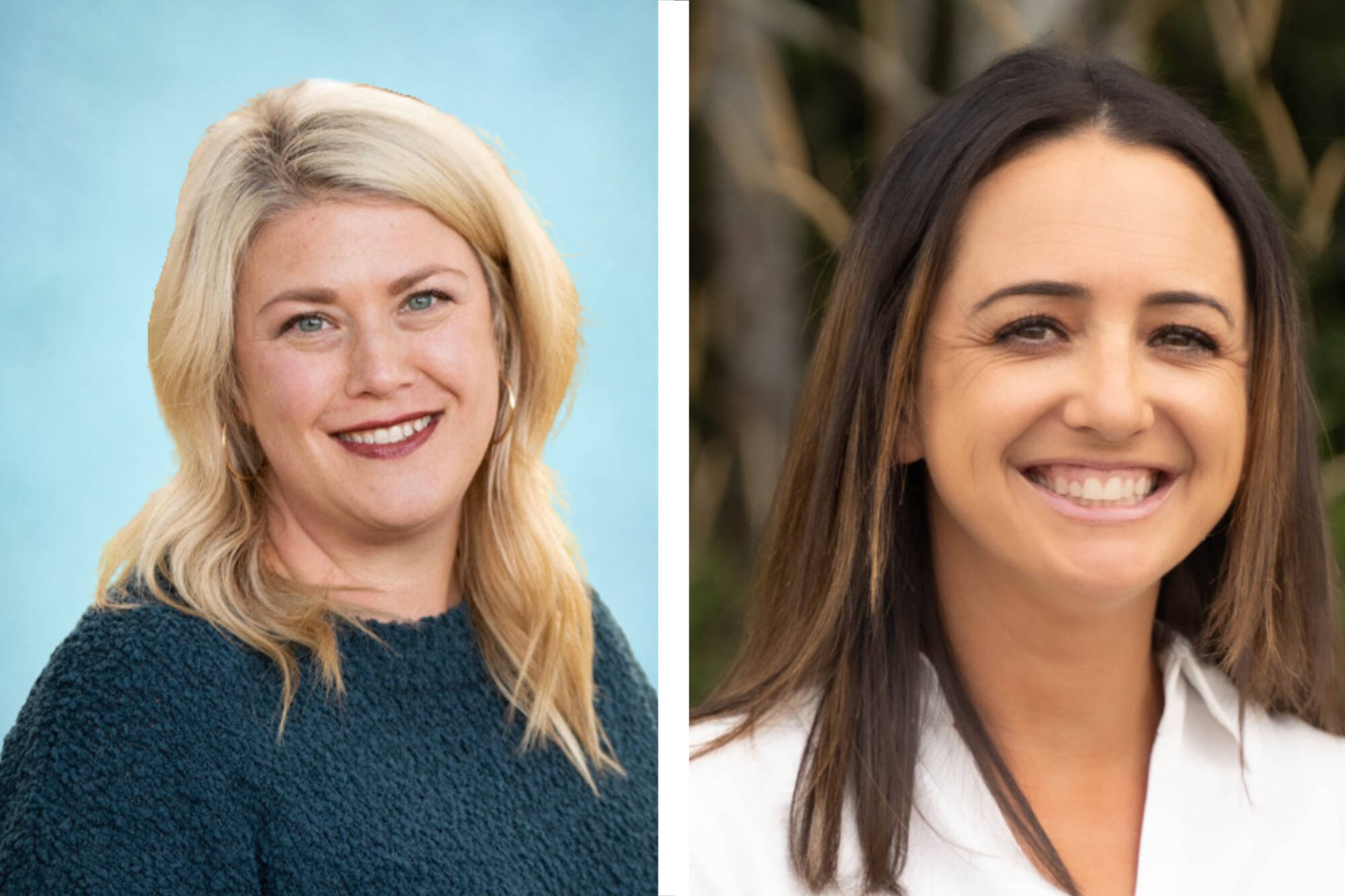
Enumclaw and Black Diamond will find two positions on their ballots this election: District 2 incumbent Julianne DeShayes and challenger Tara Cochran, and District 5 incumbent Paul Fisher and challenger Malia Ebner.
You may have seen a few scattered signs around town and a meet-and-greet here and there; you can also learn more about DeShayes at julianneforschools.com or Cochran at votetara.org, but the races have largely been quiet.
So it’s time to meet your Enumclaw School District Board incumbents and challengers.
The Courier-Herald asked each candidate seven questions about their education or elected official experience, how to increase public trust in the district, and what hot-button issues they want to address as a school board member. Each candidate had between 300 and 400 words to respond; the candidate’s answers will alternate, starting with the incumbents’ up top.
Below are DeShayes’ and Cochran’s responses; you can find Fisher’s and Ebner’s answers here.
1) Do you have any experience being an elected official or educator?
DeShayes: I have been on the school board for 4 years.
And while I’ve never been a classroom teacher, I spent several years teaching church youth group and Sunday school classes, and more recently, art classes to both children and adults through my business.
Cochran: While I’ve never served as a school board director, I bring over twenty years of experience as a dedicated educator in both elementary and middle school classrooms. This perspective sets me apart from current board members and allows me to serve as a bridge between district decision-making and the realities teachers and students face every day.
Throughout my career, I’ve taken on numerous leadership roles beyond the classroom, including RTI facilitator, building learning coordinator, new teacher mentor, instructional coach, and serving on curriculum adoption committees.
These experiences have given me a broader understanding of how to support student success at both the classroom and district levels. I’m passionate about teaching and learning, and I’m eager to bring that passion, along with a positive, collaborative spirit and fresh ideas, to help continue the important work our school board is doing.
2) One of the biggest issues ESD has had in recent years is the inability to pass a bond or levy to address critical maintenance issues. Do you support going back to the voters to go for another bond — which could potentially include building one or more school buildings — or levy? If so, when do you think it might be appropriate to do so?
Cochran: I understand the importance of passing a bond or levy to address critical maintenance and facility needs but before we ask voters again, we need to understand why previous measures failed.
The school board must actively listen to the community’s concerns. Whether they’re about safety, academic results, or financial transparency, the district needs to make meaningful changes based on that feedback. Trust is the foundation of any successful bond or levy campaign. We can’t just ask for support, we need to earn it. That means improving communication, showing fiscal responsibility, and demonstrating that we’re responsive to the community’s values and priorities.
Once that trust is rebuilt, I believe our community will absolutely rally behind a well-crafted plan that truly reflects their input.
DeShayes: I wish schools were funded differently, but until they are, the current method to obtain funding for a capital building project is to go to the community to ask for it.
Having been on the board for the last four years, I am deeply aware of the needs that we have with regard to the state of our buildings. No one likes new taxes but at the bare minimum, we can agree that our our kids deserve to learn in buildings that are warm and dry.
I would prefer to put a levy before our community because the smaller dollar amount of a levy would result in less of a tax impact to voters, but I am concerned that some of our most critical buildings are going to be beyond the scope of what a levy could address. I’m not sure when another bond could be placed before voters as the most urgent need will be renewing the EP&O and Tech levies, which are likely to come before voters next year.
3) Given ESD’s difficulty in finding voter support, it’s possible that future levies that normally get wide community support could fall through. This includes the four-year Educational Programs and Operations Levy and six-year Capital Tech Levy, which expire next year. Would you support putting these levies on a ballot next year?
DeShayes: I support bringing both of these levies before our voters next year.
These levies equal 15% of our district operating budget. To eliminate this funding would be so detrimental to our students. It would mean the loss valued staff like our para educators, classroom aids, and health room professionals. It would mean larger class sizes, cuts to the arts, electives and athletics, even the reduction of some basic services like library support and bus routes for our kids.
No one wants that for our students. The good news is that if these levies come before voters in February, they will be replacement levies allowing the funding for essential people and programs to continue with no tax increases to the community.
Cochran: I support putting both the Educational Programs and Operations Levy and the Capital Tech Levy on the ballot for renewal next year. These levies directly fund essential services that our students and schools rely on every single day. The EP&O Levy covers counselors, nurses, security staff, custodians, librarians, paraeducators, transportation, playground maintenance, athletics, and fine arts—critical components of a safe, well-rounded, and effective school system.
I believe our community values these services and understands their importance. The Capital Tech Levy is important as well. It ensures students and teachers have access to up-to-date devices, classroom technology, infrastructure support, and professional development—tools that are no longer optional in today’s learning environment.
That said, we can’t ignore the larger financial picture. ESD is currently spending about $17,659 per student. This is significantly more than White River School District, which is achieving better academic outcomes while spending just $12,208 per student. That’s a serious concern, and it must be addressed. Renewing these levies should go hand-in-hand with a firm commitment to improving financial efficiency and academic return on investment. We owe that to our students and our taxpayers.
In addition to tightening our spending, I’d like to see us pursue creative funding solutions such as grants, community partnerships, and philanthropic support, to expand our resources without placing the full burden on local voters. Renewing these levies is essential but so is accountability. We can and must do both.
4) Trust in the district is low — it seems especially so when it comes to spending. How do you feel about the board’s current transparency with the public? Are there any ways you think the board can improve communication with parents and voters?
Cochran: Transparency and clear communication are absolutely essential to rebuilding trust between the school district and the community. The board does present financial information publicly. The full budget is available at meetings, however, this information often doesn’t reach the broader community.
The issue isn’t just transparency; it’s also engagement. Board meetings are open, but attendance is consistently low. We need to make these meetings more relevant to families and community members. One way to do this is by regularly recognizing student achievements and hosting celebrations during meetings to encourage family attendance.
A board that genuinely listens to public comment and responds with clarity and follow-up will also help rebuild trust and foster a sense of shared responsibility. Communication with parents must improve. There have been serious incidents — such as break-ins, lockdowns, and health scares — where information was not shared promptly or clearly. That delay undermines parental trust and raises safety concerns.
Families deserve timely, accurate communication in moments like these so they can feel confident their children are safe and the district is being proactive and transparent. If elected, I’ll advocate for stronger communication protocols, more family engagement strategies, and a culture of responsiveness that brings the community back into partnership with our schools.
DeShayes: The issue of “trust” comes up often. I’m aware of it, and transparency has been a focus of mine since I joined the board.
It is as important to me as it is to the community. This is a great time to remind everyone that school board meetings are public and anyone is welcome to attend. The agendas are published ahead of each meeting, and all of the hyperlinks are included, including budget and enrollment information. Minutes from every meeting are available on our website. We’d love to see you there!
But I think it’s worth noting that many conversations concerning schools are happening online, in public social media groups and forums. I believe it is imperative to go where the conversations are happening, and because of that, I have really tried to engage in the dialogue in those spaces. Sharing information openly, explaining decisions clearly and engaging people in meaningful ways builds trust, and I try to do that in every interaction I have as a school board member.
I’ve been known to share my personal cell phone number in many a public forum to encourage people to reach out with additional questions or concerns. I believe that transparency means we have to involve the community in the decision making process, and give local citizens the opportunity to inform our decisions; the FOCUS committee that was created to explore the capital facilities needs of the district is a good example of this.
In addition, I have championed a public online dashboard for future capital spending projects where community members can see, in real time, where money is being spent, and what projects are being completed. I am absolutely committed to keeping our district transparent, responsive and connected to the community we serve.
5) According to the National Assessment of Educational Progress, the 71% of Washington 8th grade students overall were at grade reading level, and 63.3% students in math. At the Enumclaw School District, 64% of 8th graders are proficient in reading, and 40% in math, according to the school district. What is the district doing/what can the district do to improve these scores?
DeShayes: In my time on the board, systems alignment has been a big focus for our district. We needed to streamline some things so that all of our students were being taught to the same standards, and so that learning goals were aligned across the district. I was supportive of this, as well as supporting the addition of a master schedule in all of our buildings.
The master schedule helps to ensure students are present for important classroom instruction, and builds time into the day for interventions like speech therapy or specialized instruction. The district has also really focused on making data driven decisions. Instead of relying solely on the data gathered at the state level (the results of which come too late in the year to make much of an adjustment in teaching strategies), our district is assessing our students with locally developed benchmarks three times during the year, allowing for students needs to be identified and monitored so that our systems can support them sooner.
We have also adopted both math and ELA curriculums, and I love getting updates from our teachers and seeing the progress our kids are making as a result of these changes.
It’s always exciting to see the growth in our kids reflected in test scores, but ultimately, I believe there is more to a quality education than just test scores. I believe in the deep, authentic learning experiences provided by our teachers and staff, and I believe in partnering with them as we work together to improve outcomes for all kids.
Cochran: These percentages are not where they should be and they certainly don’t reflect the talent and dedication of our educators.
The issue isn’t the teachers. The teaching staff has an average of 15 years of experience and 77% of them hold Master’s degrees. ESD teachers are highly skilled and committed. They are ready and capable of increasing student achievement if they are given the support they need.
To improve these scores, the district must prioritize academics and refocus resources and leadership where they matter most.
First, we need to address barriers to learning such as low attendance and extreme student behaviors that are disrupting classrooms and preventing learning. The district must commit to a consistent discipline policy to ensure classrooms can focus on instruction.
Teachers are also being pulled away from instruction by state mandates and non-academic requirements. We need to safeguard time for reading, writing, and math especially at the elementary level through daily WIN (What I Need) time, where targeted instruction happens based on student skill gaps.
At the middle and high school levels, academic interventions must be implemented with fidelity not just scheduled, but actively monitored by building administrators. Leaders need to be present in these spaces, helping ensure interventions are responsive and effective.
Friday early release time is provided to support teacher collaboration.
Professional Learning Communities (PLCs) are essential for analyzing student data, but they only work when teachers are given time, support, and clear goals. Administrators should participate in PLCs regularly, helping staff drill down to student-level, skill-by-skill data.
Each building needs to set high, clear academic goals and check in on them frequently. This is especially critical at the middle school level, where academic performance is a known area of concern. When data shows a problem, leadership must act quickly and collaboratively to adjust instruction and supports.
We know improvement is possible because we have the right people in the classrooms. Now we need the right leadership focus and systemic supports to match. ESD’s future depends on academic achievement being the top priority.
6) There are a lot of hot button issues when it comes to school board elections — book bans, land acknowledgements, sex-ed and sex/gender curriculum, trans athletes, etc. Is there any particular issue (listed above or not mentioned) that you think should be addressed by the board? And how should the board deal with the issue?
Cochran: There’s no shortage of hot-button issues in school board elections.
But in all the noise, we’ve lost sight of the most urgent issue of all: our kids aren’t learning at the levels they should be. That’s the button we should be pressing.
Too many students are falling behind in core academic skills. They aren’t meeting grade-level benchmarks. They aren’t reading enough books. They aren’t writing on paper. They aren’t being challenged to think critically, solve problems, or innovate.
That is the real crisis. Our school board should be focused on academics in every classroom and at every grade level. When we prioritize high-quality instruction, rigorous standards, and strong support for teachers, our students will rise to the challenge. They can and will achieve at high levels if we commit to an education system that puts learning first.
DeShayes: With regard to any of the issues posed in this question, it is important to note that the board is first tasked with following the law. And regardless of what the issue at hand is, the board has an obligation to keep the needs of students at the forefront of our decision making.
Rather than reacting to divisive national debates, the board should stay grounded in our mission: inspiring students to learn, lead and impact their community and world. We should absolutely address issues as they arise, and we should do so by focusing on facts, listening to understand, and respecting differing viewpoints. I am sure there will be things that come up that I don’t agree with, but my role as a school board member isn’t to champion a specific agenda— it’s to act in the best interest of the district, and to act as a link between the community and the schools, ensuring that district operations align with community priorities.
It’s also important to remember that our district respects the role that our families play in their student’s education; our curriculums are always available for families and guardians to review, and our teachers and admin are always willing to discuss concerns.
7) Is there anything else you’d like to add about why local voters should cast their ballot for you?
DeShayes: Strong schools need steady leadership. Retaining experienced school board members like myself means keeping the momentum on long-term goals—like improving student outcomes, supporting teachers, and ensuring responsible use of taxpayer dollars. With experience comes perspective, context, and a clear understanding of where we’ve been and where we’re going. Continuity helps our district stay focused on students—not politics—and ensures progress doesn’t get lost every election cycle.
Cochran: I believe in giving back to the community.
I was raised to serve and help those around me. My father, a retired U.S. Army Colonel, served his country with honor and humility. My mother has spent decades as a Red Cross volunteer, providing comfort and support to families during their hardest days. Growing up in a home rooted in service, strong values, and compassion, I learned that true leadership starts with caring deeply for others.
As an educator, I teach students about civic responsibility and the importance of being part of something bigger than themselves. That’s not just a lesson I teach; it’s a value I live by. My husband and I have raised two incredible teenagers who are kind, intelligent, and hard-working. As a mom and a community member, I care deeply about the future of our schools and the well-being of every child who walks through the doors. I have a lifelong commitment to service, and I will work hard to ensure our district remains focused on what matters most: our kids.