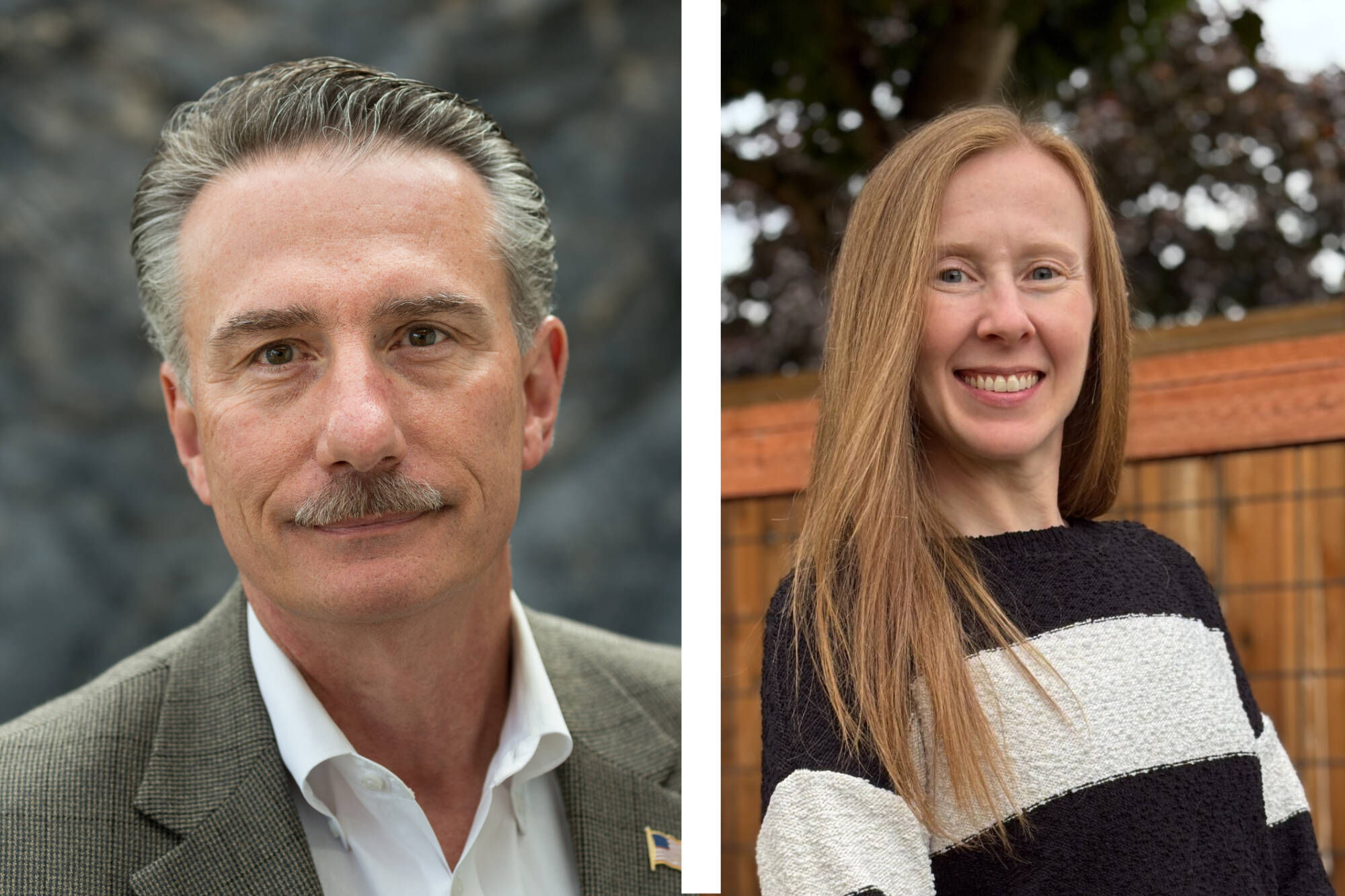
Enumclaw and Black Diamond will find two positions on their ballots this election: District 2 incumbent Julianne DeShayes and challenger Tara Cochran, and District 5 incumbent Paul Fisher and challenger Malia Ebner.
You may have seen a few scattered signs around town and a meet-and-greet here and there; you can also learn more about DeShayes at julianneforschools.com or Cochran at votetara.org, but the races have largely been quiet.
So it’s time to meet your Enumclaw School District Board incumbents and challengers.
The Courier-Herald asked each candidate seven questions about their education or elected official experience, how to increase public trust in the district, and what hot-button issues they want to address as a school board member. Each candidate had between 300 and 400 words to respond; the candidate’s answers will alternate, starting with the incumbents’ up top.
Below are Fisher and Ebner’s responses; you can find DeShaye’s and Cochran’s answers here.
1) Do you have any experience being an elected official or educator?
Fisher: 4 years in December. This will be the end of my 1st term.
Ebner: I have no experience as an elected official or public-school educator. I do, however, have experience hiring, interviewing, and training employees from our local communities. This gives me a unique view of how young adults are showing up in a work setting post-graduation as they start their adult life. I also have experience in creating and managing multimillion-dollar budgets. I understand what it takes to ensure funding is put in the right place, especially when money is tight.
2) One of the biggest issues ESD has had in recent years is the inability to pass a bond or levy to address critical maintenance issues. Do you support going back to the voters to go for another bond or levy? If so, when do you think it might be appropriate to do so?
Ebner: I support going back to the voters to address critical maintenance issues within the district.
The district will pull $1.5 million from the General Fund in 2025-26 to pay for capital projects, like roof repair to Byron Kibler. While this is a smart option for the short-term, it is not sustainable. The General Fund is meant for supporting day-to-day operations to keep our schools running, including teacher pay. If we want our students to thrive in our community and beyond, we need to ensure we are putting our money in the right place to ensure student success.
Over the next three years, it is estimated the total student population in Enumclaw will go from approximately 4,350 students to 4,870 students. Most of this growth is in Black Diamond, so an additional school may be necessary. The full cost of this new school should not be shouldered by our residents but heavily invested in by the developer. I support asking for funding from our residents to bring our current schools up to the standards that we expect for our children. In terms of timing, the district will be looking to renew critical levies in 2026, which I think should be our top priority.
Fisher: Over the past two years voters have decided not to support two bond requests and one capital levy request.
I believe a number of factors have contributed to this outcome; the COVID shutdown, dissatisfaction with remote learning, public anger over masking once we returned to the classroom and the uncertainty of the economy following national elections.
With that said, the district needs to focus on winning voter support for the two current levies that will end early next year. I do not anticipate that the board will look to ask voters to support a new bond until 2027.
3) Given ESD’s difficulty in finding voter support, it’s possible that future levies that normally get wide community support could fall through. This includes the four-year Educational Programs and Operations Levy and six-year Capital Tech Levy, which expire next year. Would you support putting these levies on a ballot next year?
Fisher: The board and district staff will need to make sure that we effectively communicate to voters the importance of approving these two levies. So, many important programs would have to be eliminated, and support staff terminated if these levies are not approved.
Also, with both levies, the district will be asking to keep the tax rates the same. So, no increase in tax will be requested.
Ebner: I do support these levies on the ballot next year.
This is not an additional cost for our residents, and this money covers critical programs for our students. 50% of the Education Programs and Operations Levy covers salaries and professional development for staff that are not funded by the state. The other 50% directly benefits our students: Security, Athletics, Clubs, Transportation & Food Services. Losing these funds would have a direct and immediate negative impact on our students, staff, and the greater community.
4) Trust in the district is low — it seems especially so when it comes to spending. How do you feel about the board’s current transparency with the public? Are there any ways you think the board can improve communication with parents and voters?
Ebner: Trust is low across the community as a whole.
Social media makes this worse because you can’t have a one-on-one conversation with the people that have the answers to your questions. The board’s current transparency is sufficient if you know where to go to find the information that they are lawfully required to publish.
However, trust is built by showing up and having conversations with community members, including coffee chats, visits to local organizations, representation at community events, and so on. The board is required by law to be transparent, but trust is built above and beyond transparency.
Fisher: I encourage the community to attend board meetings or to review the meeting’s minutes. The minutes are posted on the district’s website.
All policy decisions are made during open public meetings, and these decisions are included in the meeting minutes. Anyone making a public comment during a meeting receives an email response from the board regarding their comment.
The district’s monthly financial statements, which include line-item expenditures, are also posted on the district’s website.
Speaking for myself, I am always willing to take a call, email or meet in person with parents or concerned citizens to discuss any issue.
When it comes to spending, the district is financially responsible. So many school districts in Washington State are operating in the red and have even had the state step in and take control of operating the district. Enumclaw School District is financially sound because the board and district staff have made it a priority to operate within budget.
5) According to the National Assessment of Educational Progress, the 71% of Washington 8th grade students overall were at grade reading level, and 63.3% students in math. At the Enumclaw School District, 64% of 8th graders are proficient in reading, and 40% in math, according to U.S. News. What is the district doing/what can the district do to improve these scores?
Fisher: I am not pleased with these test scores.
However, I am very pleased with the district’s work in our middle schools and high school making sure that every student is thinking about their future and that they have a career plan when they graduate.
In our most recent graduating class, 50% will attend a 4-year college, 14% will attend a 2-year college, 11% will attend a trade school, 8% will enter an internship program and 5% will enter the military.
While not everyone is captured in these numbers, our goal is to capture everyone. Regarding test scores, over the last two years the district’s teaching & learning staff has evaluated and adopted new Math and English curriculums and is doing detailed tracking of student improvement.
I believe the district is on the right track, and year over year, we will see a positive trend in test scores.
Ebner: The district is on the right track to improve these test scores, but there is still a lot of work to be done. According to the OSPI website, we score lower than our neighboring White River School District across ELA, Math, and Science.
To improve these scores, the district can and has implemented curriculum to help students best communicate their learning in these test formats. I do want to emphasize, though, that state testing is only a portion of measuring student success.
If we want a thriving community of citizens, we must teach to more than just the state tests. We must teach critical thinking and communication skills and give opportunities to students for vocational training or education beyond high school.
When hiring, I have never asked an adult how they performed on their state tests. I have, however, asked how they work with others to contribute to the success of the group.
6) There are a lot of hot button issues when it comes to school board elections — book bans, land acknowledgements, sex-ed and sex/gender curriculum, trans athletes, etc. Is there any particular issue (listed above or not mentioned) that you think should be addressed by the board? And how should the board deal with the issue?
Ebner: The role of the board is to ensure every student, regardless of their background, receives a high-quality education that prepares them for success in school and life.
A school district’s goal should not be to indoctrinate children into one way of thinking but to teach children how to think critically about a topic. I think the board should approach these topics from that mindset.
Fisher: As a board member, I was elected to represent the views of the community and to advocate for policies that are consistent with those views. The safety and wellbeing of students will always drive my decision making.
7) Is there anything else you’d like to add about why local voters should cast their ballot for you?
Fisher: I am committed to ensuring all students are prepared to enter the workforce or to go on to more formal education when they graduate from Enumclaw High School.
To that end, I will continue to focus on academic excellence and exposing our students to a broad range of career options.
I ask for your vote so I can continue this important work.
Ebner: Our responsibility to the children of the district is significant because they will grow up to be the adults that create our future community.
I want that community to be thriving. I have two children with distinctly different learning needs in the school district. In conversations with other parents, teachers, and students, I have seen where this district shines, and where there is opportunity. I want to represent these voices to district leadership.
As a board member, I will hold the district accountable for ensuring student success and utilizing taxpayer funds responsibly.