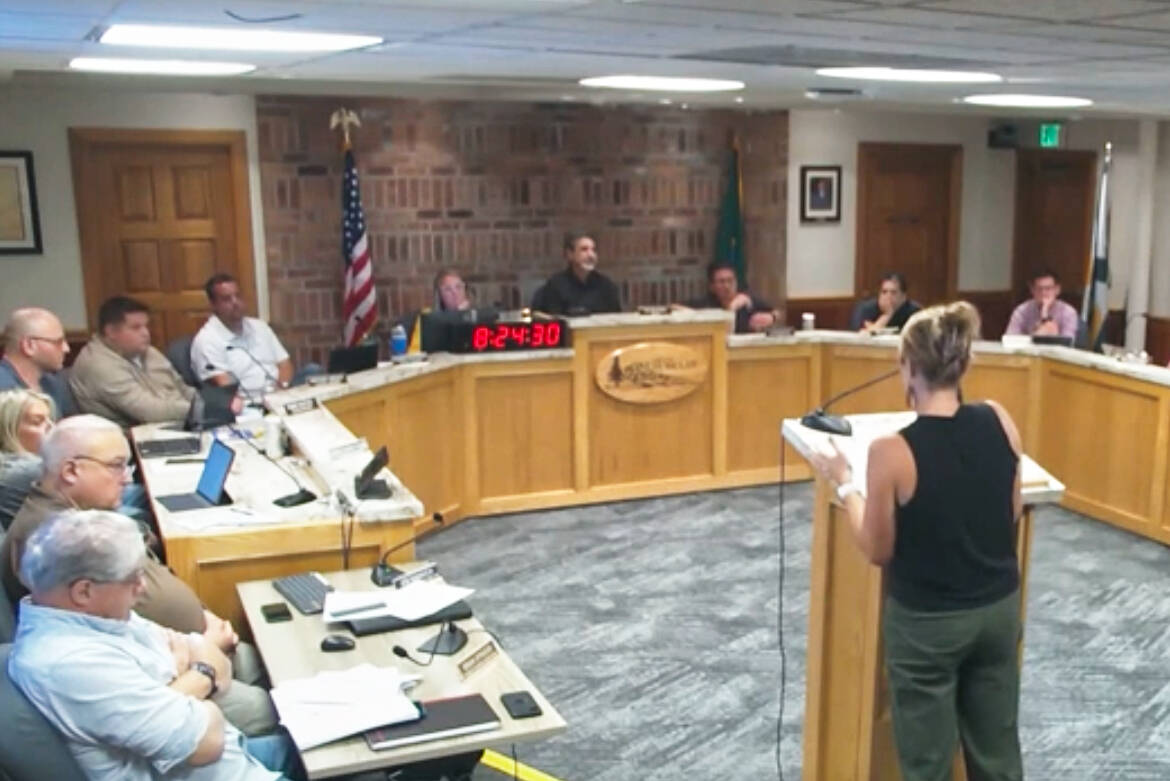
The Rainier Foothills Wellness Foundation gave a sunny update to the Enumclaw City Council.
Executive Director Sara Stratton shared with the council on June 23 that the nonprofit’s school counselor program had “it’s most successful year yet,” according to the therapists.
The program is partly funded by the city, as well as the city of Black Diamond, King County, Mutual of Enumclaw. This is the fourth year the program has operated.
Currently, the program has two full-time therapists that split their time between Enumclaw Middle School, Thunder Mountain Middle School, and Enumclaw High School, for one-on-one sessions and group sessions.
This year, 119 students utilized the program (down from about 200), with more than 1,500 individual therapy sessions.
Although less students have used the program this year, that’s not a bad thing, Stratton said, as some students who needed short-term aid no longer require seeing a counselor and some referrals are now referred to the district’s guidance counselor or an outside service, instead of RFWF’s being a “catch-all”.
“Our therapy session count hasn’t changed,” she continued. “[Students are] just getting more support, because they’re more in-depth, longer-term issues.”
These long-term issues include being on free/reduced lunch or homelessness, which Stratton considers “barriers to access” of services like what her nonprofit provides.
The program is free to students. This is important, Stratton said, as this allows students to have “more in depth therapy and greater focus on tools and coping skills.”
During the 2023-2024 school year (last year’s data is not yet available) 35% of the student utilizing the counseling program were on free/reduced lunch. Additionally, about 6% were homeless.
Stratton said that most students see counselors for depression and anxiety, but a not insignificant percentage of students are also diagnosed with Post Traumatic Stress Disorder. She noted that there were fewer cases of COVID-19- or school-related anxiety, allowing counselors to focus more on students with chronic anxiety, depression, or PTSD.
While individual students are receiving aid, it’s possible that the counseling program is having an effect on the schools overall, especially Enumclaw High.
According to Stratton, there was a 10% decrease in disciplinary actions between the 2022-2023 and ‘23-24 school year. Additionally, there was a 14% improvement in GPA between ‘21-‘22 and ‘23-24, from an average of 1.96 to 2.23.
Current data was unavailable by the time the presentation was given, but “with the shift in the students we are serving and the needs we are seeing, our therapists agreed that this was their most successful year,” Stratton said. “The numbers may not look like it, but… our therapists are seeing students learn. They’re able to spend more time with them and give them tools and resources and coping mechanisms rather than just putting out fires. They’ve seen students leave substance abuse behind. They’ve seen students, for the first time ever, have hope for their future and talk about and think about a career path.”
The whole program costs about $138,000, and Stratton noted that funding can be hard to come by.
She thanked the current funders, but specifically thanked Mutual of Enumclaw for agreeing to a two-year pledge.
“This program is hard to fund, especially given our community’s demographics… so if we can get multi-year commitments of support, I am very grateful, personally,” she said.
SENIOR HOT MEALS
Stratton also gave an update on the RFWF’s Senior Hot Meals program
When the program first started delivering hot meals to local seniors in 2012, serving 30 seniors, the program has now more than doubled to 70 residents, thanks in part to the nonprofit’s new kitchen space that allows them for “unlimited” food prep time, Stratton said.
The number of routes has also increased, from four to six.
Nearly 8,700 meals have been served Mondays, Wednesdays, and Fridays so far this year; dinner also comes with a cold lunch for the following day.
“Not only do they get the meal, but every delivery includes social interaction between the volunteer driver and the senior,” Stratton said. “… That’s a huge part of this program as well, as a lot of these seniors that we serve… they’re not getting out. The reason they’re on the program is they’re somewhat homebound.”
It costs the Foundation about $5 a meal, including packaging.