
Correction: The Courier-Herald misreported that Leg. District 5 Rep. Marie Gluesenkamp Perez was at this event. She did not attend. The article has been updated.
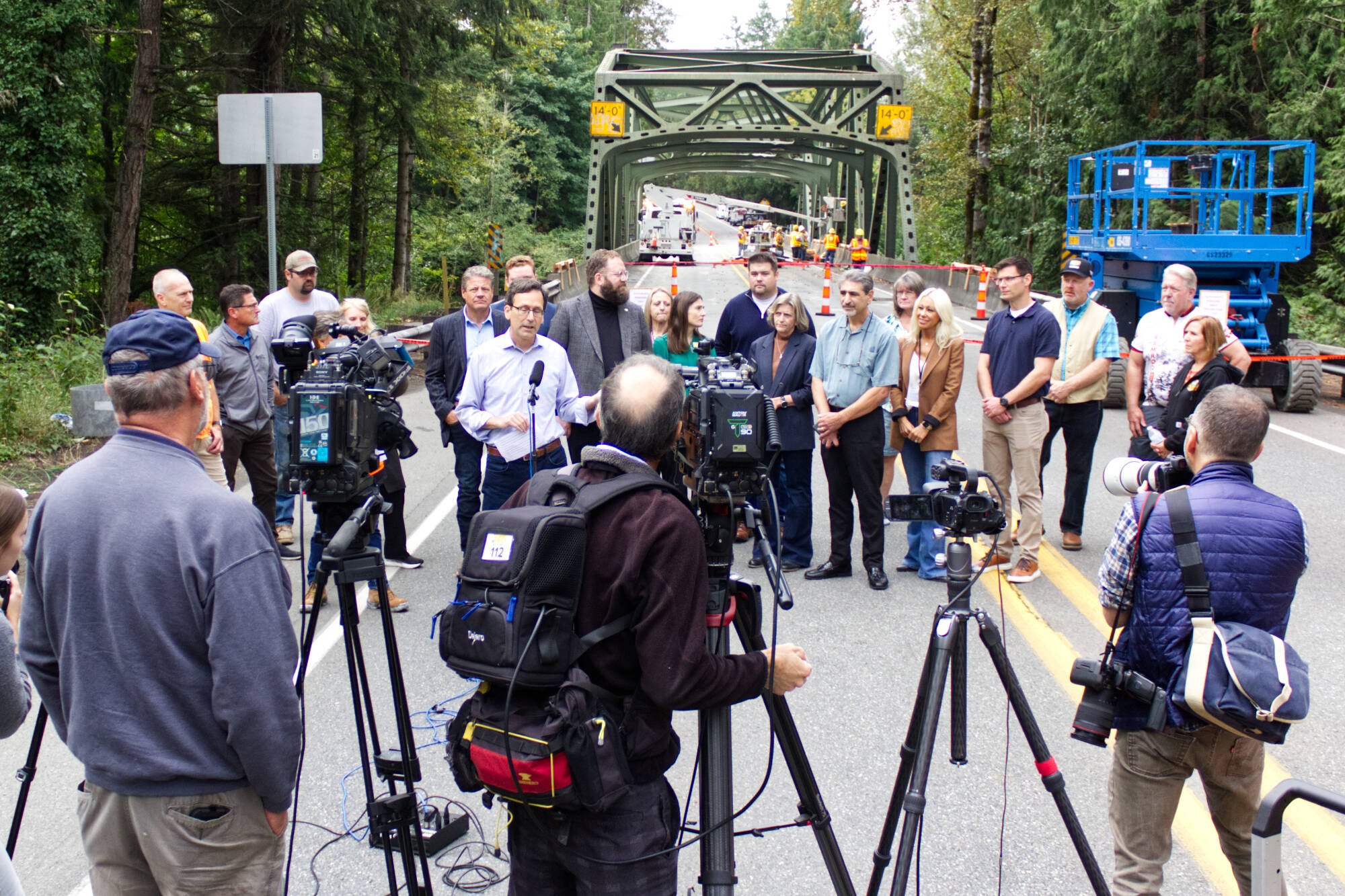
Gov. Bob Ferguson announced that work on the White River Bridge will be done “seven days a week,” with a goal of opening the critical structure by Nov. 15.
It was a who’s who of local politicians, state officials, and concerned business owners gathered at the bridge on Sept. 8 to hear Ferguson’s announcement and ask questions of Washington State Department of Transportation officials.
In addition to Ferguson were Enumclaw Mayor Jan Molinaro and nearly the entire city council; Buckley Mayor Beau Burkett and Carolyn Robertson Harding, current president of the Buckley Chamber of Commerce and soon-to-be city executive; Enumclaw Chamber CEO Kerry Solmonsen; business owners like Ryan Lundeen and City Council member Jan Martinell; Enumclaw School District Superintendent Dr. Shaun Carey; King County Council member Reagan Dunn; Legislative District 5 Rep. Victoria Hunt; WSDOT senior bridge engineer Geoff Swett; Secretary of Transportation Julie Meredith; and dozens of reporters and camera operators surrounding the group and WSDOT employees actively working in the background.
The big news was that Ferguson and WSDOT hope to have an emergency contract signed with a private firm by Sept. 15 to start repairs as soon as possible.
“The work is going to be seven days a week,” Ferguson said, noting that construction is, of course, dependent on weather and the availability of materials. “… Folks are losing their jobs as a result of what’s going on. People are having a challenging time getting prescriptions, to visit their doctors, living their lives… so we’re here to also say we hear that, we understand that, and that’s why as governor, WSDOT, and our whole team, why we’re working as fast as we can to get this done as quickly as we can.”
WSDOT Secretary Meredith touched on her department’s previous plan to open the bridge to one lane, alternating traffic, and why WSDOT is instead moving straight into permanent repairs.
“I know there is potentially some people that are disappointed that we aren’t opening it to single-lane traffic,” she said. “But moving directly into permanent repairs under an emergency reduces the time it will take for this long-term construction [to get] underway.”
Meredith added that the bridge would have likely been closed all through December if it opened to one lane and closed again for construction.
The whole cost of the project, Meredith said, could be between $5 and $6 million; WSDOT has said there is no funding for a whole new bridge.
Ferguson stressed that the state can and will foot the bill if necessary out of WSDOT’s preservation fund, but because he declared the White River Bridge closure an emergency, he will be seeking federal funds from the Federal Highway Administration.
“We have the resources to do this on our own as a state,” he said. “It’s absolutely necessary to get this job done.”
WSDOT is also working with the company of the vac truck that damaged the bridge for third-party compensation via insurance, though Meredith and Ferguson declined to go into further detail about this process at that time.
While WSDOT is looking for compensation, so are local business owners.
“Is there going to be any sort of help for the businesses that have suffered?” Lundeen, who owns three businesses in Enumclaw, asked the governor.
“We’re in regular communication with leaders here, community leaders. I’ll be visiting some businesses after we leave here, just to check in and listen directly from business owners,” Ferguson replied. “… Right now, our focus is to get this thing fixed right as quickly as possible.”
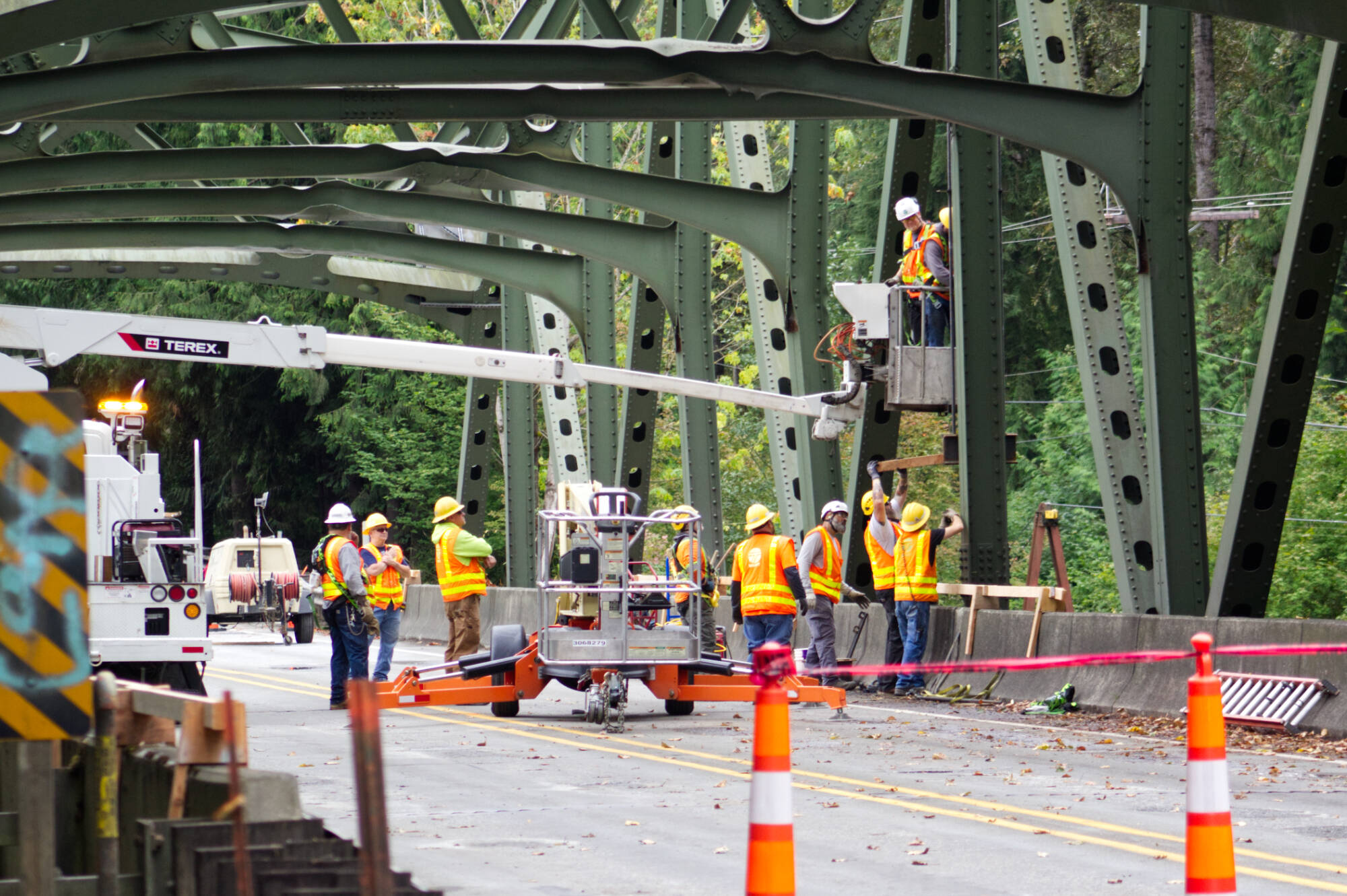
WSDOT is already at work installing temporary bracers on the bridge. The steel they are using is five times stronger than the steel used to build the bridge in 1949. Photo by Ray Miller-Still
BRIDGE DAMAGE
The damage to the bridge is “significant” and greatly dwarfs what happened in 2015 when an oversized vehicle hit a support beam.
Swett walked reporters and other attendees through how badly the bridge was damaged by a vac truck when it was hit and closed on Aug. 18.
The vac truck “hit the portal of the bridge” (the first cross member) “and hit all five of the sway braces” (which keeps the wind from moving the bridge), Swett said.
“Those sway braces, some of them are bent out of plane… up to four feet,” he continued. “… When those bent, they also pulled in the vertical numbers of the truss that are connected to those, and bent those pretty severely.”
After listing additional damages to the structure, it became clear how much worse this situation could have become.
“We were actually really lucky that we didn’t have another Skagit River incident here,” Swett said, making mention of the 2013 I-5 bridge collapse when an oversize load struck the overhead support beams. “… The design of this truss is a little different than that one. It was a little more resilient, and we didn’t lose the whole bridge, thank goodness.”
At this time, WSDOT is putting in five temporary bracers with steel that Swett said is five times stronger than the steel used to build this bridge.
Once that is complete and a private contract signed, Swett expects repair work to include heat straightening the sway frames (where you heat the metal to expand it, move it back into position, and let it cool) and, if necessary, replace members that can’t be straightened.
This is similar to how the bridge was fixed in 2015, though on a much larger scale.
After repairs are complete, the bridge will also be painted.
Buckley Chamber President Harding asked if these repairs will actually improve the bridge’s rating, which until this closure was “fair.”
Swett said he’d follow up with his team, but added that the goal is to get the bridge back to the way it was, and not necessarily improve it in any fashion.
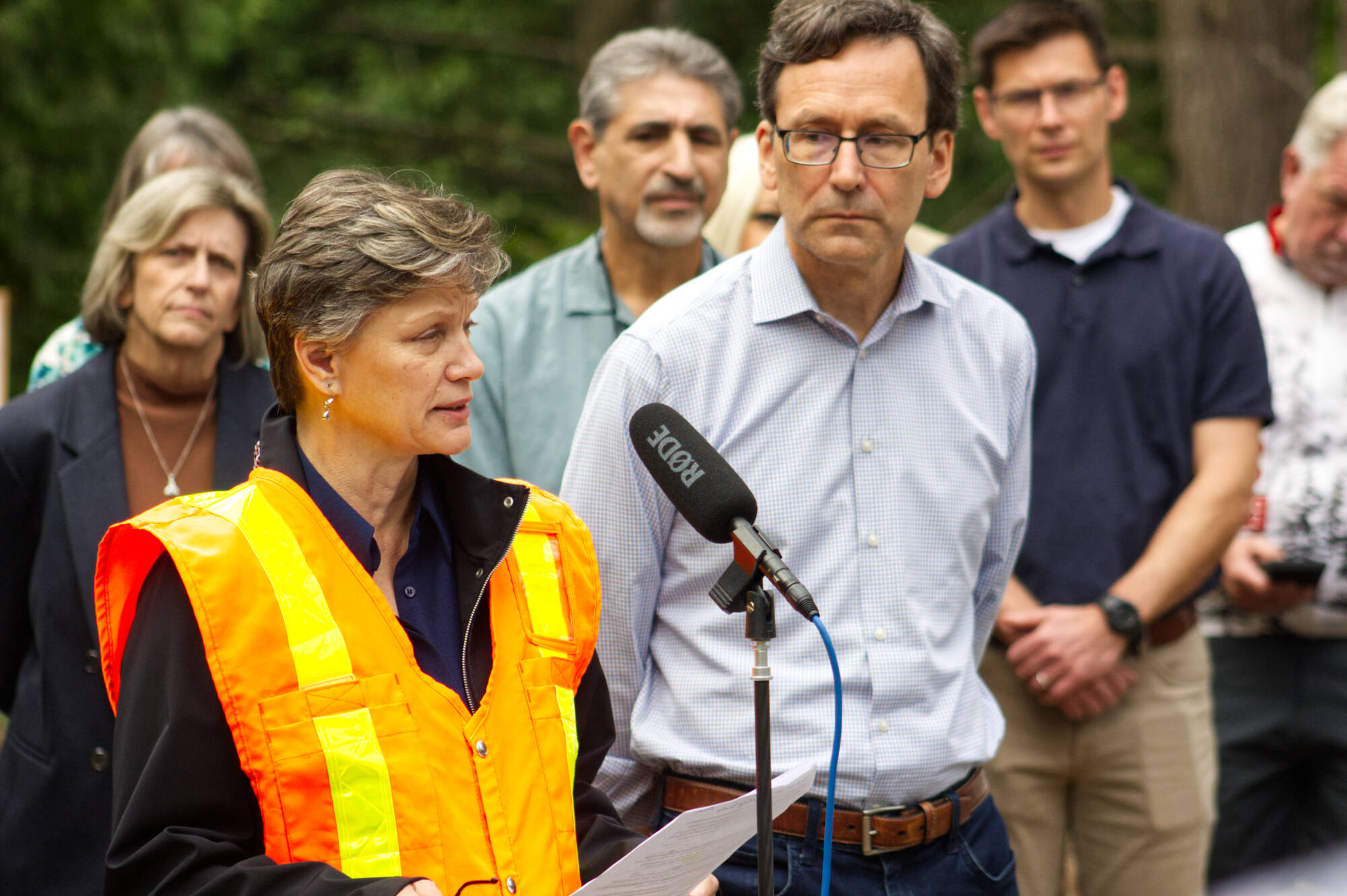
WSDOT Secretary Julie Meredith said that if the bridge opened to one lane as originally planned, repair work could have stretched until the end of the year. Keeping the bridge closed for permanent repairs should speed up this process. Photo by Ray Miller-Still