King County Transportation District sales tax debate continues
Published 2:10 pm Tuesday, April 28, 2026
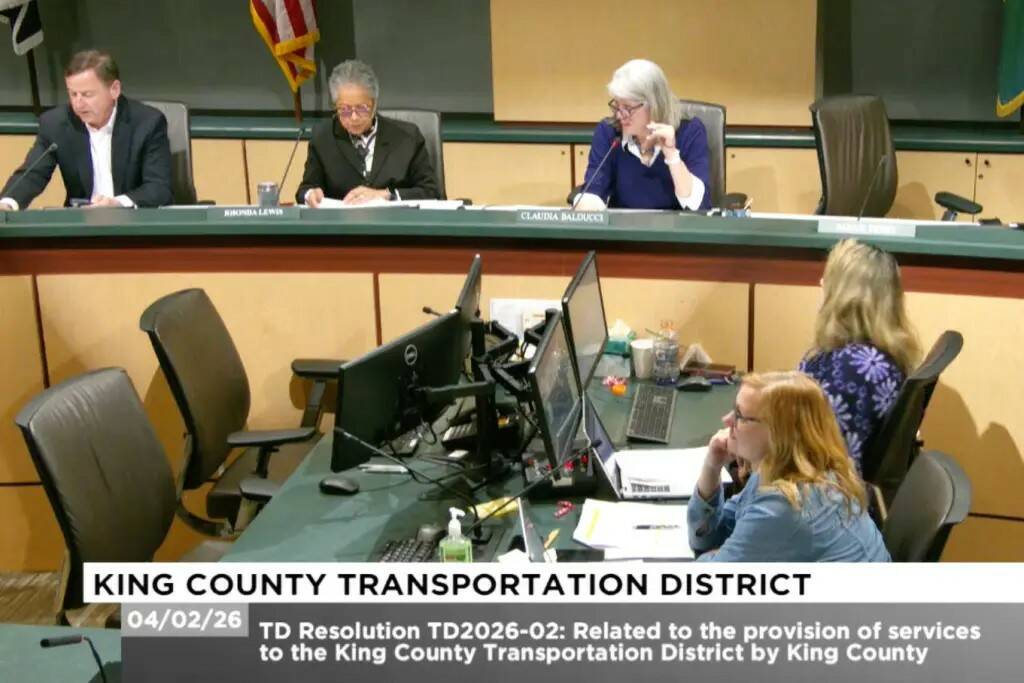
The King County Transportation District continues to debate a sales tax increase to fund both unincorporated roads, and how much the county and other cities may share the pot.
The Transportation District’s Executive Committee – Council members Claudia Balducci, Steffanie Fain, Rod Dembowski, and Sarah Perry met on April 22 to further hash out details before the whole body of the special tax district meets again for possible action.
Being discussed is a 0.1% sales tax increase that would fund the county’s Roads Services Division and mitigate an annual $200 million budget shortfall, which has plagued the department for several years. Approving such a tax increase will be the first time the Transportation District will have used its powers to do so since it was formed in 2014.
Without the tax increase, the Roads Services Division will have to eliminate its capital fund by 2028, meaning the county won’t have funds to tackle scheduled, new, or emergency road projects.
While everyone appears to be on board to approve of the tax increase, which can be done without a vote of the people, how that money should be split with King County cities continues to be the issue at hand, as well as how cities would access those funds.
Some council members propose that 25% of all funds collected will be given to cities proportionate to how much sales tax revenue they bring in.
Others propose 12.5% of all tax revenue be distributed to cities.
Council member Perry was a strong proponent of the latter.
“None of the cities are losing their funding by 2028,” she said. “None of the cities are in as dire a situation as we are.”
Perry also proposed that only cities with $150,000 people or less have funds be available to them, saying that Seattle and Bellevue would take half of the pot and leave far less funds available to smaller cities.
“It doesn’t make sense to me that that meets what our intention is with this, to give yet more finding to well-funded spaces,” she said.
Council member Dombowski voiced support for the full 25% and for not excluding any cities.
“I think we’re at our best when we don’t single out and exclude certain parts of our region,” he said. “… People start poking at each other and it can have consequences in other areas of work.”
Council member Balducci, chair of the Executive Committee, said she’d vote for either, if that would allow the sales tax measure to pass.
“75% of $100 million is better than 0% of $100 million,” she said.
Perry also proposed that cities should apply for tax revenue, like with how the King County Flood Control District controls its funds, rather than have them receive it automatically
“As a King County tax we have to be in the business of really making sure that the public dollars are used for what King County intends,” she said.
Dombowski disagreed, referencing King County’s current troubles with alleged fraud at the Department of Social Health Services, King County Regional Homelessness Authority, and most recently, an investigation revealing hundreds of thousands of dollars in contract funds went to a county employee’s family.
“I think that a very efficient, formulaic distribution to the cities is the way to go. Let them spend it on anything authorized by statute,” he said. “.,..[E]ach city has its own needs, and just I would defer to their judgement on this, in large part because it doesn’t sound like it’s going to be a lot of money.”
Proposals for sharing the new sales tax funds are expected to be formally introduced at the Transportation District’s May 7 meeting.
Any amendment is likely to benefit the Plateau with additional funds for transportation projects inside Enumclaw and Black Diamond.
The cities may also see benefits outside their borders, as the Enumclaw, Black Diamond, and South King County contains about 18% of all the miles of roads the Road Division is responsible for, and nearly a quarter of all the bridges.
In total, the Roads Division is charged with maintaining more than 1,500 miles of road across the county, as well as the drainage pipes, guardrails, signs, and more alongside them.
The Roads Division operates with a $129 million budget and a $25 million capital programs budget, bringing its total budget to about $154 million.