Survey shows fewer ESD tenth graders “at risk” of problematic internet use, more with higher levels of hope for future
Published 2:00 pm Tuesday, May 26, 2026
Enumclaw School District tenth graders are reporting higher levels of hope and appear less at risk of problematic internet use, according to the 2025 Healthy Youth Survey.
The biennial assessment is coordinated by numerous state agencies to analyze the wellbeing of students grades 6 – 12, and asks questions about everything from substance use to bullying and dietary behaviors to school and home safety.
The online survey results only go as deep at King County average results, but the Enumclaw School District provided their students’ specific results to The Courier-Herald.
One hundred and eighty six students participated in the 2025 survey out of the 316 enrolled, which the district said was an adequate sample size for the survey.
The Courier-Herald examined three topics: problematic internet use, substance use, and mental health— which includes how hopeful local tenth graders feel about their future.
PROBLEMATIC INTERNET USE
The Healthy Youth Survey started asking students about their internet and social media habits in 2021, meaning there’s only three data points — including this most recent survey — that gives any indication of whether students are becoming more at risk, or less, of problematic internet usage.
The HYS uses a “3-item Problematic and Risky Internet Use Screening Scale” for this assessment, which examines how much time students spend on the internet or social media, how using (or withdrawing) from the internet or social media contributes to negative emotions like anxiety or anger, if a student neglects responsibilities or loses motivation due to internet use, and more.
Students who score a 3 or higher are labeled as “as risk.”
The percentage of “at risk” students have been rising and falling.
In 2021, the first year these questions were asked, 45% of students were labeled “at risk.”
That rose to 56% in 2023, but dipped to 42% last year.
Nearly 32% of respondents last year reported spending several times a day on social media, or about once an hour; another 29% reported they use social media more than once an hour.
Just over 10% of students reported they feel “withdrawal” when they’re away from the internet, and almost 16% said they often lost motivation to do things because of being online.
ESD tenth graders match the county-wide results, which report a drop of “at risk” students from 53% in 2023 to 41% of in 2025.
“This is a relatively small decrease, but it is a statistically significant one,” Office of Communications & Health Education Equity Public Information Officer Miki Kaneshiro said in an email, pointing out that it’s a similar decrease at the state level, from 47% in 2023 to 42.7% last year.
SUBSTANCE USE
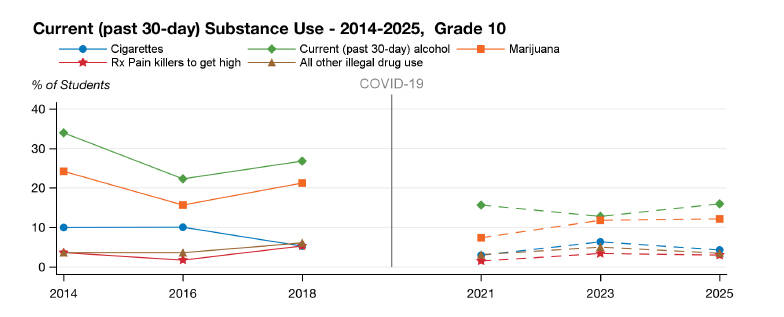
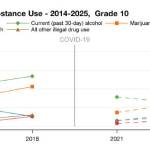
While substance use reports are down from pre-COVID 19 pandemic levels, alcohol and marijuana use reports increased slightly from previous years.
Back in 2018, the last pre-pandemic survey, 27% of students reported drinking alcohol within the last 30 days prior to taking the survey. In 2021, the first post-pandemic survey, that dropped to 16%.
Reported use dipped again in 2023 to 13%, but rose last year back 16%.
Of those who reported drinking alcohol, nearly a third reported experimental drinking (one to two days of drinking, no binging), while another third reported heavy drinking (three to five days of drinking, and/or a binge) and the last problem drinking (six or more days of drinking, and/or two or more binges).
County-wide reports came in at 7% in 2025.
Reported marijuana use is also lower than pre-COVID than now, but the numbers are rising slightly.
In 2018, 21% of students reported using marijuana in the last 30 days. In 2021, that dipped to 7.5%.
Reports have risen to 12% in 2023 and 2025.
About half the students who reported using marijuana (close to 6%) said they’d used to ten or more days in the past month.
About 3% said they only used it one to two days out of the month.
County-wide reports are down to 4% last year.
Local reports of cigarette use came in at just over 4% this year, and pain killers and other illegal drug use reports at 3% and 3.5%, respectively.
MENTAL HEALTH
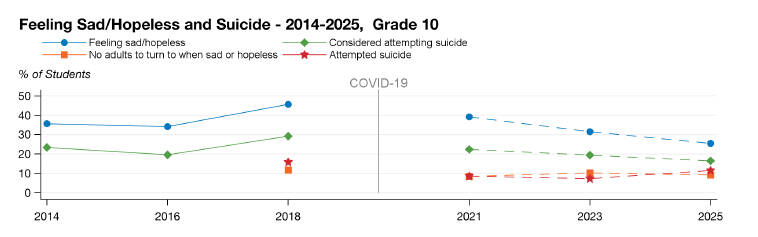
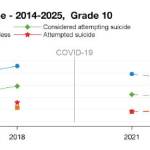
Enumclaw High 10th graders are reporting fewer instances of feeling as or hopeless, but an increase in attempts in suicide.
According to the Healthy Youth Survey, 39% of 10th graders reported feeling sad or hopeless in the past year in the 2021 survey.
That’s dropped to 25.5% this year.
But the percentage of students who said they attempted suicide rose from 8.6% in 2021 to 11.5% last year.
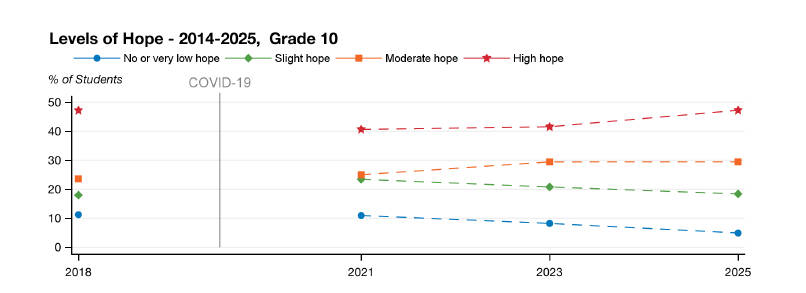
Overall, however, ESD tenth graders have reported rising levels of hope.
Hope is measured by the answers to questions that determine a students’ ability to use multiple paths to solve problems, believe they perform as well as their peers, understand that their past experiences will help in the future, and can meet goals.
Based on answers to these answers, students are labeled as “highly hopeful” about or “no or very little hope” about the future, plus two in-between.
The percentage of highly hopeful students rose from about 41% in 2021 to 47% in 2025, matching the level students reported pre-COVID in 2018.
At the same time, the number of students feeling “no or very little hope” dipped from bout 11% in 2021 to about 5% last year.
That’s lower than the state average, which came in at 50.6%.
According to the HYS, students feeling high levels of hope consistently find their classes more interesting, believe that their education will be very or quite important later in life, receive A and B grades, and believe they can receive help in school if needed than students who feel “little to no hope.”