EPD installs first Flock automatic license plate reader camera
Published 11:30 am Thursday, June 25, 2026
CORRECTION: The Courier-Herald misreported the total number of ALPRs the EPD will be using. There will be eight total cameras, not six. The article has been updated.
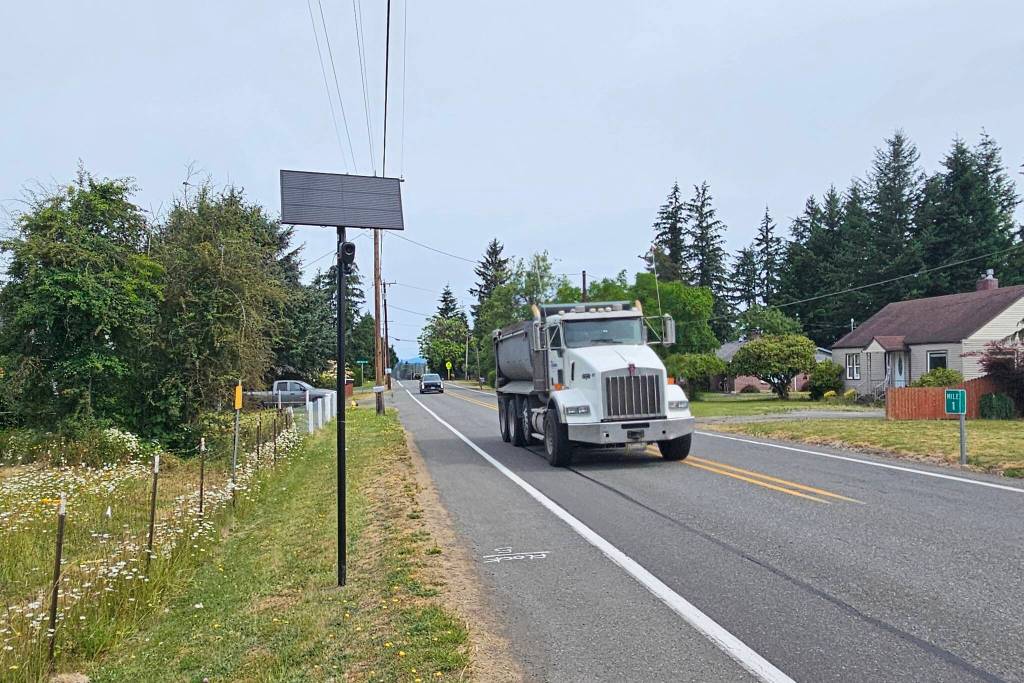
The Enumclaw Police Department has installed its first Flock Safety automatic license plate reader, with seven more to come.
The first ALPR is currently on Porter Street at 427th to capture southbound traffic; the rest are expected to be installed by the mid-July, covering northbound traffic on Porter (two total cameras) as well as traffic going both ways around SR 169 and 416th Street (two cameras) and 410 and Semanski Street and Farman Street (four cameras).
At this time, the EPD’s Flock cameras are not operational, and will only start collecting data when all six cameras are installed.
These cameras, which are supposed to intended to capture license plate information and some details of vehicles, are controversial across the country.
Supporters have said they help law enforcement respond more quickly to ongoing crimes as well as pick up new leads when searching for suspects.
There have been some high-profile arrests that were aided by ALPRs. One such example was the apprehension of Jeffery Zizz, who allegedly kidnapped and murdered Thurston county grandmother Marcia Norman and buried her in concrete before building a shed over her in Olympia last spring; law enforcement credit ALPRs for putting Zizz’s truck in Olympia around the time of Norman’s disappearance.
More locally, ALPRs were used to apprehend a suspect after a “shots fired” report in Auburn on May 24 in under a minute, and another camera around Auburn aided in the arrest of Jenee Amber Westberg, accusing of stealing an Enumclaw horse from its farm, earlier this month.
“Flock Safety ALPR cameras have proven time and time again to be a valuable tool to recover stolen property, develop investigative leads and find missing or endangered people,” Enumclaw Police Chief Tim Floyd said when the Enumclaw City Council approved an ALPR policy last August. “The Enumclaw Police Department is looking forward to having technology commensurate with the jurisdictions that surround us, so that we can partner seamlessly with our neighbors in our crimefighting efforts and provide a high level of customer service to our community.”
But opponents often say these cameras give the government and law enforcement too much power to track everyday citizens and threaten civil liberties.
According to the Institute of Justice, a libertarian nonprofit public interest law firm, there have been at least 20 incidents of police using ALPRs to stalk romantic interests in recent years. The April report wouldn’t include the arrest of three Cherokee County, Georgia deputies after they were allegedly using ALPRs for non-law enforcement reasons, though it was not immediately clear what those reasons were.
The city of Lynwood canceled its contract last February after a University of Washington report found that out-of-state agencies accessed its collected data “seemingly for the purposes of immigration enforcement,” the Everett Herald reported, adding that the Lynwood Police Department’s system was only accessible to out-of-state agencies for nine days.
In that time, more than 100,000 searches were made, and at least 16 directly related to immigration enforcement.
The ability for law enforcement to share its data with outside agencies can be turned on and off, and was a feature that some departments were not aware of; the cities of Kent and Auburn also changed how it shared with outside agencies after the UW report was published, but continue to partner with Flock Safety.
The EPD said the city decided to move forward with contracting with Flock Safety at least in part because other surrounding cities use the technology, which can be shared between departments.
“… [W]e did not want to be a safe haven for criminals to move about freely and undetected,” an EPD June 24 Facebook post reads. “Flock cameras have been linked to a 60% reduction in commercial burglaries, [an] 80% reduction in residential burglaries, and a 40% reduction in robberies in some areas, and we expect that our Flock system will also assist in the reduction of crime in the region.”
FLOCK CAPABILITIES AND EPD POLICIES
Here’s the gist of how ALPRs work.
ALPRs capture the license plate data and limited other information about all vehicles that pass by.
If a car is being suspected of being involved in a crime, and details of the car, like color, make, model, and apparent damage to partial or full license plate information, that information is put into the Flock system in order to find “hits” of where that vehicle has been seen.
This can happen immediately, in the case where vehicle information is readily available, or later, when more leads are developed.
Depending on the severity of the suspected crime, hits can be restricted locally or can come from other departments.
All photos of vehicles not associated with a crime are normally hard deleted within 30 days of a photo being taken.
However, Washington state law limits data retention to 21 days.
Finally, these Flock ALPRs cannot be used to determine if a vehicle was used in a traffic violation, like speeding.
The department will be following recently-passed state laws regarding ALPR use.
Before Senate Bill 6002 passed last March, ALPR use in Washington was mostly governed via contracts between municipalities and other governments and ALPR companies.
The new bill mostly codifies most standard contract language into law, but it also limits what crimes law enforcement can use ALPRs to investigate, how long law enforcement departments can retain data – see above – and requires departments to make annual audit reports available to the public and submit them to the legislature.
How departments can use ALPRs to make traffic stops seems relatively unchanged: officers can’t use a “hit” as probable cause for a traffic stop, but instead have to develop “independent reasonable suspicion” for the stop.
Alternatively, officers would have to immediately confirm visually that the “hit” was correct and also confirm by other means that the license plate is in another system, be it the state Department of Licensing or another law enforcement database, local or federal.
“This has always been the case essentially. Even with a stolen hit on a plate, an officer would be required to visually confirm the plate and then re-confirm the stolen hit before taking enforcement action,” Floyd said at the time. “This was standard language in most ALPR department policies, including ours, prior to the legislation. The legislation just memorializes it.”
However, the bill only allows law enforcement to use ALPRs to investigate gross misdemeanors and felonies, and not misdemeanors.
And while Flock contracts required law enforcement departments to have the ability to audit their ALPR use – which includes tracking which officer was searching for what plates – annual reports will be required to be made available to the public and submitted to the appropriate legislative committee by December 2027.
Audit reports must include the number of hits that resulted in traffic stops, arrests, and prosecutions; the number of stolen vehicles and recovered license plates; the total number of license plate reader reads and searches that yielded results; the number of times data was shared with or accessed by another government entity; and the location of cameras, among other requirements.
EPD reports are required to be put “conspicuously” on the city’s website, and Floyd confirmed the department will have a public-facing portal that will be able to see how many hits we get once the system is running.
Floyd also said that only in-state agencies will be given access its Flock database, and the EPD said in a June 24 Facebook post that the new state laws about ALPRs make data collected by the cameras unavailable to the general public.