Donating marrow through the Be The Match Registry could save a life
Published 11:40 am Tuesday, November 15, 2011
By Neil Johnson
For The Courier-Herald
As you may know, in February I was diagnosed with Chronic Myelogenous Leukemia. With medication it is possible to hold the CML in a chronic phase, however in March I went into blast crisis forcing me to receive emergency chemotherapy at UW Medical Center.
This began my relationship with the Be The Match Registry which helps people who need a life-saving marrow or cord blood transplant.
With November being National Bone Marrow Awareness Month, it is important to know how easy it is to become a donor and with thousands of patients with leukemia and other life-threatening diseases needing a bone marrow or umbilical cord blood transplant, they depend on the Be The Match Registry to find a match – someone like you.
It is easy to become a member of the registry and potentially save a life. All you need is to be between the ages of 18 and 60, be willing to donate to any patient in need and meet the health guidelines.
The process involves a registration form and swab to the inside of your cheek. Financial donations will be accepted to help cover the cost of testing. You can get more details about the Be The Match Registry by visiting www.bethematch.org or http://marrow.org/Home.aspx.
Keep in mind, if you are chosen as a potential donor then all costs related to the testing and donation process are picked up the patient’s medical insurance or the registry. In my case, our insurance will be billed $75,000 for the cost of the donation.
Because the markers used in matching are inherited, patients are more likely to match someone from their own race or ethnicity. The most favorable match is with a full blood sibling, but did you know that only 30 percent of patients find a donor in their family?
Unfortunately, I was not one of the lucky 30 percent; however I was one of the other 70 percent that was able to turn to the extended human family of Be The Match Registry, so I was fortunate. Adding more donors and cord blood units from diverse racial and ethnic backgrounds to the Be The Match Registry increases the likelihood that all patients will find the match they need.
But even with a registry of millions, there still are not enough matches for all patients, especially those from racially and ethnically diverse communities. Your heritage can make all the difference, so please check into becoming a donor.
Looking back at the process I went through, I am thankful there was a young lady somewhere in the U.S. who decided to become a donor. This donor was our third shot after the first two had various issues and were not able to follow through with the donation process.
At the beginning of the process we thought I would have many choices since I was Norwegian but, low and behold, we found I am not full-blooded Norwegian, which is why the search for a donor was in the single digits, not the hundreds as expected. As you could imagine, I was nervous about the entire process and what it meant to have a nine out of 10 match versus a 10 out of 10 match.
What if we couldn’t find a match? And how long could my cancer remain in remission waiting for a match?
Once a donor was secured in July you could only imagine my mixed bag of emotions, including excitement when my transplant date was set for Aug. 16. This meant my pre-treatment would begin on July 28 at Seattle Cancer Care Alliance.
The pre-treatment consisted of various tests, pill chemotherapy, bone marrow aspirations, pulmonary testing, spinal tap and other blood work to make sure I could handle the transplant.
Once completed, I checked into the UW Medical Center on Aug. 13 and started my final chemotherapy treatment which ultimately wiped out all my hair. I think it was wishful thinking on my part that after my first three chemo treatments (March, April, and May) when I didn’t lose my hair, that I could hold onto to it during this final treatment.
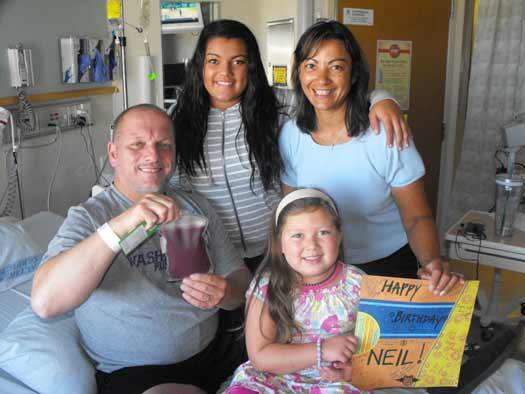
The transplant itself is just like receiving a blood infusion (see picture) and is painless. Any pain or discomfort comes from the chemotherapy treatment and for me I was fortunate during my transplant that everything went fairly smooth compared to how they prepared me for the worst.
I had a few tough days, but in the big picture I was told that I was handling the process better than expected. The transplant date changed from the 16th to the 17th due to some issues in collecting the stem cells from my donor, so in the afternoon of the Aug. 17 I started receiving my new stem cells and received my first birthday card from our nurses.
During the next two weeks it was a matter of recovery and waiting for my new stem cells to take hold, so once this happened and my white blood cells hit a certain number they released me from the hospital. This took place on Aug. 31 and I started my follow-up treatment at the Seattle Cancer Care Alliance on Sept. 1.
Today, I am at day 79 post-transplant and we are currently going through my discharge testing.
As I transition back to my doctor in Puyallup, I continue to reflect on how fortunate I am to have a second chance at life which would not be the case if the young lady I received my cells from didn’t sign up on the registry, but most importantly stay committed to the process.
It doesn’t cost the donor a penny when they are found to be a match, it just costs their time. The donation process is so much easier and less painful than in years past and what greater gift can one person give than the gift of life? Please take a few minutes to get more details about the Be The Match Registry by visiting www.bethematch.org or http://marrow.org/Home.aspx.
Your gift of donation can save a life. It saved mine.
Neil Johnson is the mayor of Bonney Lake.