“I was a Middle-aged Wolfman”: New book recounts local’s efforts to bring wolves back to Idaho
Published 2:20 pm Thursday, October 2, 2025
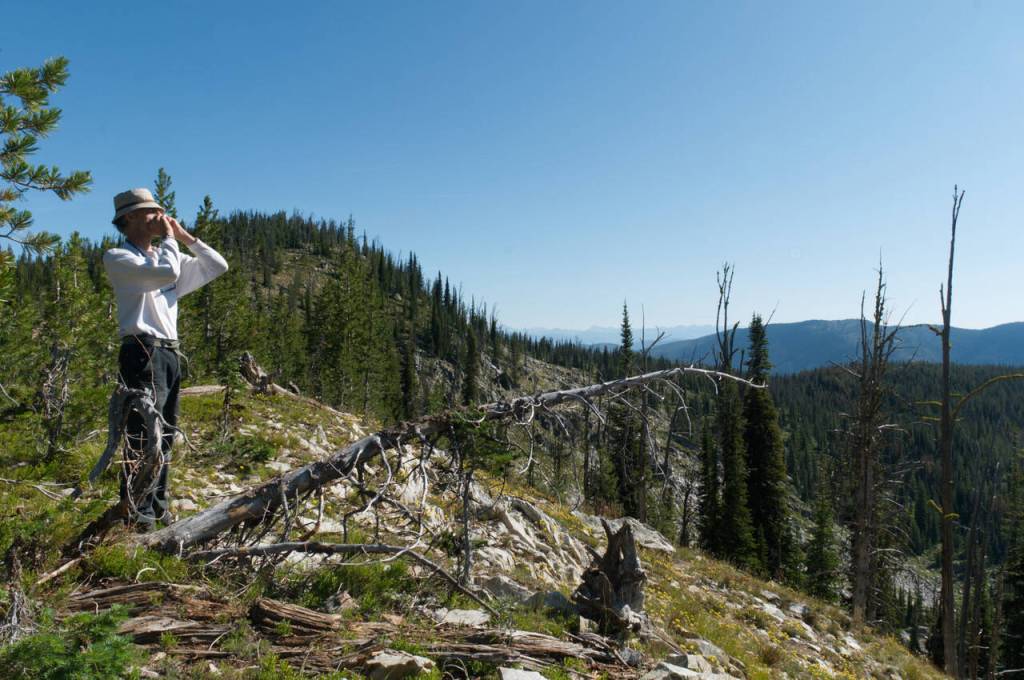
If you ask him, Jim Holyan would say he never considered himself a scientist — of wolves or otherwise.
Instead, the local postal worker said he was “just somebody who ran around the woods trying to count wolves.”
That’s fairly reductive, as Holyan was one of just a handful of people in the country during the 1990s and 2000s tasked with overseeing the reintroduction of wolves in central Idaho.
A niché career, definitely, but crucial in understanding wolf behavior and adaptability, especially as it relates to how governments can manage wolf populations; Holyan’s work is featured in several scientific studies published by organizations like The Canadian Field-Naturalist to the Journal of Wildlife Management.
But his new book, “I was a Middle-Aged Wolfman: Chasing Wolves in Idaho’s Backcountry” isn’t about any of that — it’s about him in the field, helping bring back an animal species that was all but wiped out in the country in the 1920s.
Holyan always loved animals. He never had any pets while growing up in Enumclaw, but he fondly remembers going “elk hunting” (how his family phrased elk spotting) with his grandparents, fishing, and evening picnics.
This led to him getting a degree in wildlife management from Washington State University in the late 1980s, which included working as a volunteer at the Kenai National Wildlife Refuge trapping wolves.
“I wasn’t even specifically focused on getting a job working with wolves — I’ll just take whatever anybody has,” he said. “… After we caught that first one… looking at that animal, something about it just captivated me.”
As he described in his book, “It embodied the wildness, freedom, and in-the-moment-ness that human society loses with each new subdivision or Starbucks.”
But jobs with wolves were scarce, and it would be another decade before another presented itself.
Since the mid-1970s, the federal government was attempting to find a way to reintroduce wolves to the Yellowstone area — after the the last wolf was officially killed in 1926, the elk population boomed. This led to overgrazing, disrupting the plant ecosystem, but the lack of large predators also allowed the coyote population to become unmanageable as well, leading to a shrinking population of smaller mammals and — perhaps most importantly to farmers who tend to oppose wolf reintroduction — an increase in domestic livestock attacks.
After two decades, the U.S. Fish and Wildlife Service found a balance between concerned farmers and wolf advocates to introduce the predator back to the national park, and 15 wolves were brought down from Canada in 1995.
Holyan was brought onto the scene two years later, and that is where his book begins.
A decade and a half of experience in the field means his tales run the gamut — the elated highs and crushing disappointments of hunting and trapping; the unrivaled beauty and quick-tempered nature of the backwoods; the strong bonds of friends and professionals interspersed with the suspicion, hostility, and violence of those who opposed wolf reintroduction, both against scientists and the animals they’re tasked with caring for.
Of course, Holyan’s been bitten. A badge of honor? Stupidity? Perhaps both.
He’s also been stranded in the woods, when a snowstorm stretched what was supposed to be a 10-day hitch for almost another week, driving him and his friend to commit some light B&E and ration what little food they had left.
And no story is complete without a rivalry.
Holyan’s was with B-22-F. (None of the wolves he and his team ever tracked got names — it just wasn’t done.)
Many wolves, when they catch wind of a human nearby, tend to slip away with little noise or fuss; a flash of fur may be all Holyan saw before the signal from a wolf’s collar disappeared into the brush. Several of his peers would bring books out into the field, in case things got boring, but Holyan said he’d always keep his eyes on the prize.
“I’m going to pay damned good attention,” he said.
Perhaps unfortunately for him, this particular female, the head of her pack, was also canny and unusually ostentatious
“She just had a very good knack of busting you, every time, no matter how sneaky you thought you were,” he said. “She’d get you. I had this personal dual with her — can I actually elude your detection and do what I need to do?… She was something else.”
Life and death are also omnipresent characters; life in the woods may not be cruel, but it certainly isn’t kind, either.
Eventually, what turns around, comes around, and with the successful reintroduction of wolves to Idaho, Holyan eventually found himself out of a job as funding for projects like his ran dry.
That’s about when Holyan returned to his loved ones in rural King County.
“I was missing my family. I’d only get over here a couple times a year,” he said. “I missed being home.”
Holyan still backpacks as much as he’s able, and he wants to conquer the Washington portion of the Pacific Crest trail, though he admits he’s getting up there in age.
But if you find yourself braving those 2,650 miles of wilderness and hear howling in the distance, keep in mind that it could be wolves — or Enumclaw’s middle-aged wolf man.
You can buy “I was a Middle-Aged Wolfman” at The Dusty Shelf in Enumclaw.