“Gentle nature” makes Belgians top performers
Published 4:49 pm Thursday, April 30, 2009
By Jessica Keller, The Courier-Herald
If there's one thing Enumclaw resident Jim Severson knows when it comes to caring for and working with horses, it's this - a person has to love the horses to make the work worthwhile.
Fortunately for Severson, loving his six Belgian draft horses comes easily, and the amount of work that comes with them is easy to bear. And his horses, and the work they do, keeps them all busy.
But Severson's horses aren't used for heavy draft work, such as dragging logs or heavy farm equipment, like the heavily muscled horses did in the middle ages. And they'll not be found transporting beer, like the Budweiser Clydesdales. Severson's horses, which he keeps at his 18-acre farm in Enumclaw, are used primarily to compete and exhibit with - that is their job, and one that suits them and Severson well.
"You treat them well, but they aren't pets," he said.
Severson began working with draft horses in 1992, but has ridden regular-sized saddle horses for 25 years.
His attention switched from regular to draft horses because he thought driving draft horses would be more of a challenge and he liked their personalities.
"I think it was the size of the horse, and their gentle nature," he said, adding draft horses are called "gentle giants" and typically weigh a ton. "They are so big, but so gentle and willing to please and work hard, I like the combination."
Severson also likes the amount of competition available with draft horses, saying it's the novelty of the big horses that draws people to exhibitions and competitions, and there's more shows and more places to compete.
"I travel all over competing," he said.
He participates in two or three competitions per year, and performs in a few shows and parades from May through the beginning of October. Each trip takes two to three days, and Severson has traveled to Idaho, Montana, California, Oregon and other places in Washington with his horses and crew.
His current crew consists of three nieces and two daughters, which works well, Severson said, because women love the horses.
"And it's a good family event," he said. "One person doesn't do it, it takes a whole family."
At competitions, not only does Severson and his crew compete with the horses, they take care of them, prepare the horses and the equipment, exercise the animals and clean up after them. It's such a great responsibility, Severson has one person taking care of each horse.
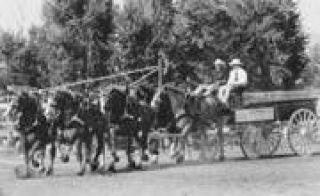
Severson has competed in each draft horse class - from single-cart driving to carts with three, four or six horses - and his favorite is the six up-hitch. That consists of six horses, in three sets of two, hitched up to a wagon.
Severson said a six up-hitch is what teamsters would drive to carry lumber or deliver other merchandise into cities before there were semi-trucks to do the job.
In competition, Severson does essentially what a teamster would do to unload his cargo: he maneuvers the team and cart around a series of cones to a simulated dock, then backs into the dock and fans the horses to the side. It's kind of like parallel parking with six horses and a wagon.
As difficult as that sounds, Severson said competing with a "unicorn" (a three-horse team) is more difficult than driving a six up-hitch because a driver needs a well-trained, obedient lead horse, which follows a separate set of commands, to lead the cart.
When Severson began driving draft horses in 1992, he started with two and then four horses to become proficient. He didn't start driving and competing with a six up-hitch until 1998, and it wasn't until last September he took first place in six up-hitch, his first ever, at a competition at Deer Lodge, Mont.
"It's been a long time getting to this point," he said.
To become adept with six horses, a teamster has to be able to communicate by voice and through the reins. He drives three teams, and has six lines per hand to control, which requires a lot of coordination and a lot of practice.
While competing with the six-up hitch isn't the hardest cart-driving event to compete in, it is the most dangerous because controlling six runaway horses after something spooks them is difficult to do and can lead to serious injury.
"And one horse out of six can cause the whole bunch to run," Severson said.
Only once has he had horses run. It was at a competition, and Severson pulled up next to a fence, not seeing a garbage can with a swarm of bees near it. One horse spooked, causing the group to charge through the fence.
"They just bolted and turned and jack-knifed the wagon and took off," Severson said.
During the down time when there's no competition, Severson works with his horses. He isn't currently preparing for any competitions or shows, but will begin practicing in April or the first of May 1. Once he begins, he'll work with his horses almost every day, for 20 minutes to a half and hour each, just so the horses know what to do.
"They have to know what's expected of them," he said.
How well Severson's horses respond to him and how he handles the team has garnered attention in the past. A person with ties to the movie industry saw Severson and his horses at the King County Fair in Enumclaw, which led to Severson debuting in a bit part on the silver screen, driving a team of horses in a movie adaptation of the Stephen King book "Rose Red" two years ago. It went so well that he is due to make another appearance in a movie - this time driving just one horse, his horse Kendall, in an adaptation of a King book, "The Diary of Eleanor Rimbaur," the prequel to "Rose Red." While he is excited about the opportunity, Severson admits it's unlikely his role will lead to future movie stardom.
"The only thing I get to say is giddy-up and whoa," he said.
But, as any Stephen King fan knows, "All work and no play makes Jack a dull boy," and Severson takes that into account with his horses as well. So while he and they share a full-time work schedule, Severson always makes sure, especially during the winter time when things aren't as busy, his horses have some time to just, well, horse around.
"I like to give them a chance to roll around in the mud and just be horses," he said. "They need to have fun too."
Jessica Keller can be reached at jkeller@cmg-northwest2.go-vip.net/courierherald