Black Diamond fire district annexation vote set for Aug. 4
Published 10:00 am Thursday, April 23, 2026

Update: This article has been updated with comments from Mountain View Fire and Rescue Chief Dawn Judkins.
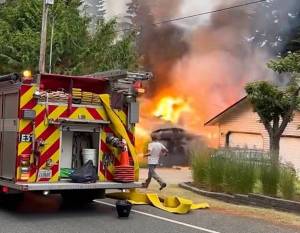
The possible annexation of the city of Black Diamond into the Puget Sound Regional Fire Authority’s fire district is to go to a vote this summer.
Elected officials approved an interlocal agreement with the emergency services provider during its April 21 meeting that would be executed if locals approve the annexation during the Aug. 4 by a simple majority.
The annexation process would take two years, and the Regional Fire Authority would begin serving city residents on Jan. 1, 2028, replacing Mountain View Fire and Rescue.
As part of this process, the city is seeking residents to form “pro” and “con” annexation committees and to pen statements for the election.
Those looking to advocate for or oppose the annexation must submit a complete application to the city clerk by 3 p.m. on April 28; the application can be found on the city website under its “public notices” page, or an application can be requested at 360-851-4500.
Committee members are expected to be appointed on April 29.
FIRE SERVICES AND TAX INCREASES
The gist of the annexation debate is this: be annexed into the Regional Fire Authority’s district and receive fire and emergency medical services for a not-insignificant property tax increase, plus a tacked-on fire benefit charge, or risk not receiving emergency services, residents being billed directly for those services, and increase the city’s insurance payments for being “unprotected.”
There is also the risk that the city will have to sign a contract with a fire department, which would likely increase the cost to the city and could also result in a property tax increase.
Here’s how the annexation would affect your wallet.
First, there will be a new property tax set at $1 per $1,000 in assessed property value. For someone who owns a $600,000 home, that comes out to an additional $600 in property taxes a year.
But there’s also a fire benefit charge, which is not a tax voted on by residents but is set by the Regional Fire Authority.
The department described the fire benefit charge as a “shock absorber,” as it is not affected by rising or falling levy rates or assessed property value levels.
The fire benefit charge is calculated based on building size, risk, and resources necessary to respond to a fire at a particular location. This means that two similarly-sized homes, even if their APVs are vastly different, would have a similar fire benefit charge.
While it can be difficult to estimate how a fire benefit charge may affect specific homeowners, the Regional Fire Authority provided some examples during its pitch to the city council in August 2025.
Two examples were of a 2,790 square foot house with an APV of $754,000 and a 2,900 square foot house with an APV of $894,000. The fire benefit charge for these homes was $330 and $336 respectively.
After factoring in the property tax, the owner of the first home would be taxed what would be roughly equal to $1.44 per $1,000 in APV — about $1,084 a year.
The second would be taxes what would be about $1.38 per $1,000 in APV — about $1,230 a year.
Bigger buildings, like warehouses and commercial businesses, are expected to have a higher fire benefit charge.
An example the Regional Fire Authority gave was a 3.372 square foot business, which was taxed $596.
But a 7,560 square-foot building paid $1,250 for the charge.
The fire benefit charge is approved by the Regional Fire Authority’s board and not voters; if Black Diamond is annexed into the district, it would have representatives on the board.
There are some limitation to how high the fire benefit charge can be, namely that the charges cannot exceed 60% of the Regional Fire Authority’s budget.
There are discounts for buildings with certain modern alarms or sprinklers, among other items and qualifications.
NO ANNEXATION?
If residents don’t approve the annexation, there’s still potential cost increases for received services and other potential repercussions.
According to state law, fire districts can bill property owners directly for the actual cost of putting out a fire when they respond to an out-of-district emergency; out-of-district medical emergency responses and transportation may also be more expensive.
Additionally, home insurance rates could increase; the Washington State Surveying & Rating Bureau may rank property that does not have designated fire protection as Protection Class (PC) 10, the lowest score.
“Most insurance companies covering property in Washington state use WSRB data as one of several inputs to setting fire insurance premiums,” its website reads.
Some insurance companies do not insure PC 10 properties.
Mountain View Fire and Rescue Chief Dawn Judkins said that if the annexation is not approved, the fire department is willing to agree to a “fair” contract with Black Diamond.
She said that currently, serving the city is a third of its expenses while only 10% of her department’s revenue, and added that Black Diamond residents pay the equivalent of less than 50 cents per $1,000 in assessed property revenue while the rest of MVFR’s district pays a $1.50 rate.