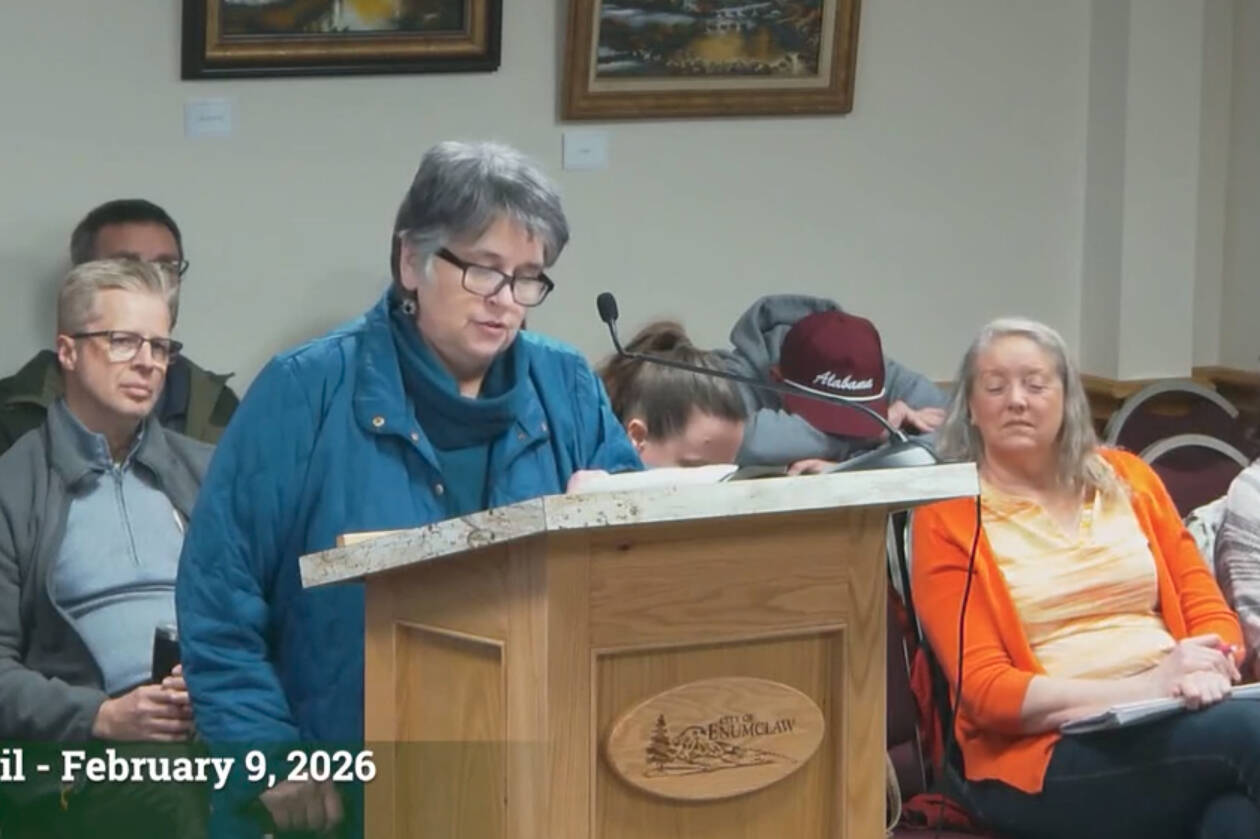
The Enumclaw City Council held a public hearing about extending a battery energy storage system moratorium during its Feb. 9 meeting.
The issue over potentially zoning for a battery energy storage system (BESS) has been discussed by the Enumclaw City Council since spring of last year.
Elected officials approved a year-long moratorium was on Feb. 24, 2025, for city staff to better research options; a subsequent public hearing was held on April 14 to confirm the moratorium.
Two people spoke at the public meeting.
First was Bonnie Helms, a Parkland resident came to speak at the hearing, adding that she was born in Enumclaw.
Helms read a letter from the city from the Covington City Council to King County that condemned the proposed siting of a BESS facility in a residential neighborhood near a school, but on unincorporated land.
“After thorough due diligence and learning about the project, we have unequivocally concluded that the siting of this BESS in a residential neighborhood and near Matson Middle School is a grave neglect of the life and safety duty you owe King County residents,” the letter reads. “As such, we vehemently oppose the siting of this facility at its current location.”
Helms also asked the council that if it doesn’t ban BESS facilities outright, that it extend the moratorium to study the issue longer.
Rita Sandvoss asked the council to proceed with “extreme caution,” siting the significant health and environmental risks that come with a BESS facility failure like fires and harmful gases.
“Please fight to protect the quality of life for Enumclaw and for the surrounding areas,” she continued. “We do not want our lovely rural community evolving into a toxic industrial zone.”
BESS facilities are, as the name suggests, power stations of batteries (often lithium) for energy storage.
One of their main selling points is that these facilities help better manage renewable energy. Since some renewable energy systems only produce electricity at certain times — solar power when there’s sunlight, wind power when there wind, etc. BESS facilities store that energy for a time when it could be best put to use, like times of high demand/low generation.
Until recently, BESS facilities were relatively unregulated in the area. In 2024, the King County Council passed legislation that established more stringent regulations about how and where these facilities can operate.
Back in Enumclaw, the months have ticked away, and now the year-long moratorium is weeks from expiring.
The options in front of local elected officials are clear: approve some sort of zoning regulation, or decide to simply ban BESS facilities from operating inside city limits. Without any policy either way, a BESS planning company could “conceivably” apply for permits, according to Community Development Director Chris Pasinetti.
According to the city’s Planning Commission, a BESS subcommittee has been formed to examine these options; the moratorium, if extended, could give the subcommittee additional time to work.
A timeline for a subcommittee recommendation to the Planning Commission, and a Planning Commission recommendation to the council, is not clear.
An ordinance extending the moratorium will be presented to the council during the Feb. 23 meeting.
SAFETY ISSUES
There are several concerns opponents of BESS facilities point out when the possibility of permitting arises.
The largest is fires.
First, lithium battery fires are notoriously difficult to extinguish, and emergency response crews have been known to simply let a fire burn out instead of trying to put it out; a May 2024 fire in California burned for five days, and there were periodic flare-ups for another eight.
Second, burning batteries release harmful gases; residents near the California BESS facility fire were ordered to evacuate the area or shelter in placeDC, and it was reported that first responders used aerial master streams and unmanned portable monitors to fight the fire to avoid fumes.
However, according to PSE and the Electric Power Research Institute (EPRI), the rate of BESS facility failures against the increasing amount of deployed energy has shrunk about 97%; while there were a comparable number of failures in 2018 and 2023, the amount of deployed energy has risen exponentially since.