

A new report maps where local philanthropy is available to support local journalism, where it’s not and where it’s desperately needed.
This should help advance the conversation of what must be done to save local news in the United States.
News outlets increasingly rely on donations to support their journalism. But philanthropy can’t fill all the gaps and, as the new report finds, its distribution and availability is uneven.
The report, “Philanthropy and Local News: Mapping Capacity, Gaps and Opportunities,” was produced by Jessica Mahone and Yanan Sun at the University of North Carolina’s Center for Innovation and Sustainability in Local Media.
It’s useful but has some shortcomings. The authors focus on local philanthropies and exclude national ones that are the biggest funders of journalism, including leaders of the $500 million Press Forward campaign launched in 2023.
Mahone, the center’s interim director, said that was deliberate because national philanthropies are well known. What’s missing is better data on what’s available and needed regionally.
“If the idea is that the funding for local news needs to be more local, we should understand that,” she said in a phone interview.
The report may also help national funders direct more support to places where the local journalism situation is dire and philanthropy is sparse, she added.
News organizations can’t expect donations to save a failing business.
But philanthropy should be one leg of the stool supporting them, along with sustainable business practices and legislation to support the industry, according to Heidi Wright, executive director of the Independent Newspaper Group trade organization.
“Philanthropy needs to be a little bit of it,” Wright said.
As the UNC report shows, it would also help if more of the charity went to news outlets in places where it’s most needed.
“Frankly, a lot of that philanthropy goes into metro areas and very, very little goes to the little mom-and-pops that are out there who are really trying to make this week’s payroll for their two journalists,” Wright said.
Growing local support for news is a priority for Press Forward, which now has 41 local chapters in 31 states, according to the program’s director, Dale Anglin.
Anglin said the chapters raised more than $100 million over the past year. She said the report prompted her to think about ways the chapters, if focused on a city or region, could support news in different parts of their states.
Even before Press Forward was created, local foundations’ support for journalism was growing, prompted by concerns about the industry’s struggles and the importance of local news to civic health and democracy.
Some charitable groups support news outlets and reporting on specific topics because it dovetails with other priorities. Most appreciate local journalism as a whole: 81% believe “civic engagement with trusted news and information” is extremely or very important, according a 2023 survey by researchers at the University of Chicago.
I’d like to see another version of the UNC report that maps both national and local philanthropies’ support for news. The local focus created a few oddities.
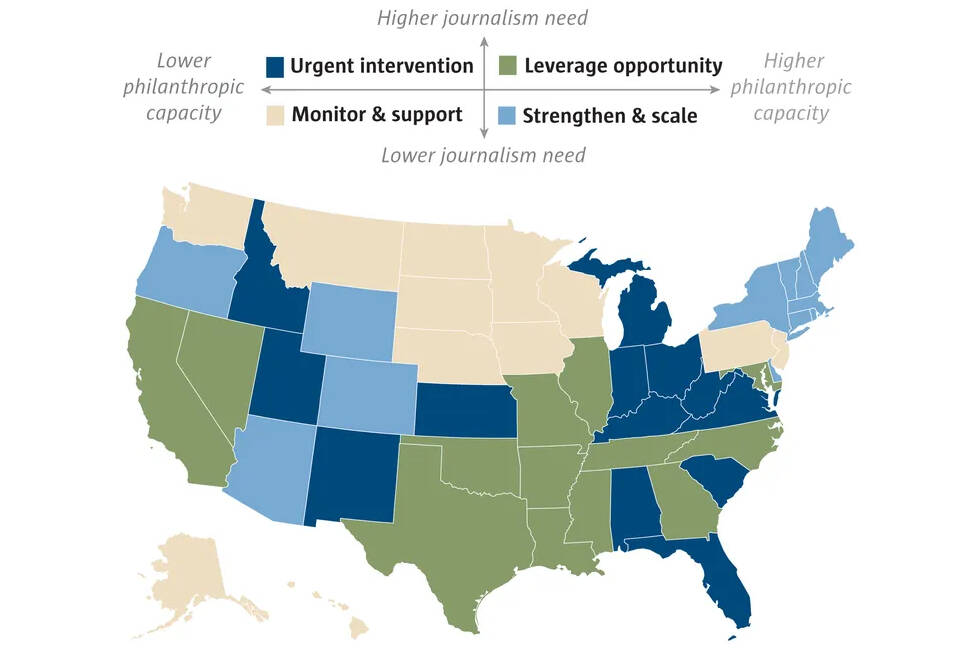
Florida, for instance, is tagged as having low philanthropic resources and limited journalism infrastructure. It’s home to the country’s largest journalism funder, the Miami-based, $2.6 billion Knight Foundation, but it wasn’t counted because it’s nationally focused.
Washington ranks lower than expected, despite being home to the Gates Foundation. The foundation is globally focused but has a state program that has supported local news, including The Seattle Times.
Mahone said it was tricky figuring out local versus national programs.
It was also harder than it should be to figure out which news organizations receive grants. The industry needs to do a better job disclosing grants and policies that prevent undue influence, which was also a concern raised in the University of Chicago study.
This gets at larger questions about the need for more transparency from nonprofit organizations and beneficiaries about their largesse.
“That’s actually why we ended up going about this the way that we did, because we could not identify definitively who is giving to local news and who isn’t,” Mahone said.
The report uses a quadrant to categorize states.
Some have more philanthropic capacity and relatively strong local journalism; the authors suggest those are places to “leverage opportunity” and “mobilize resources.”
Others have fewer potential donors and less local journalism. Those places need urgent intervention, such as national or state policies to shore up the local-news ecosystem.
States with relatively strong local journalism and few donors need to be monitored and supported, they wrote, and places with weak journalism and more donors need to “strengthen and scale” support.
Anglin said local news should not take money from programs that are foundations’ primary focus. But she encourages them to include it in the list of things they support.
“News should not be competing with any of those things,” Anglin said. “It should be the base for how everybody is understanding what happens with those strategies. So give the $500,000 to the food bank but reserve $50,000 to $100,000 for your local news source.”
Even that may be too much to ask in some places, judging from this new report.
Perhaps it will encourage Press Forward and other big funders to do more in the bleakest news deserts, at least until Congress comes to its senses and does its part to save America’s local, independent press system.
This is excerpted from the free, weekly Voices for a Free Press newsletter. Sign up to receive it at the Save the Free Press website, st.news/SavetheFreePress. Seattle Times’ Brier Dudley is the editor of the Free Press Initiative, which aims to inform the public about issues facing newspapers, local news coverage, and a free press. You can learn more about the Free Press Initiative, or sign up for a newsletter, at https://company.seattletimes.com/save-the-free-press/.
Ava Mandoli / The Seattle Times The Center for Innovation and Sustainability in Local Media at the University of North Carolina