The history of Howard Botts, ‘Mr. Black Diamond’
Published 12:15 pm Tuesday, July 22, 2025
Correction: The Courier-Herald misreported that Howard Botts did not run for a seventh term as mayor. He did seek re-election but was defeated by his opponent Rebecca Olness. The article has been udpated.
An icon. A legend. A man who embodied the best of his city.
These are only a fraction of the kind words Black Diamond residents put forward after the death of Howard Botts Jr., former mayor of Black Diamond and the city’s longest-serving public official.
Botts died Monday, July 14, after a fall left him hospitalized.
His history is well-recorded, and his measure of a person written on the hearts of many; Keith Watson, president of the Black Diamond Historical Society, called him “Mr. Black Diamond.”
Botts was born in Black Diamond in 1931, back when the city was, well, not a city, but a Pacific Coast Coal Company town; his father, H.L. Botts, was a doctor who moved to the area in 1922 and, after a brief stint in Chicago and Seattle, returned in 1929 to stay.
He worked in the mines as soon as he was able, his daughter Julie Malavotte recalled, and it was dangerous work.
At one point, Botts was using a large metal rod to break up coal as it came in on a conveyor belt.
“There was an open electrical box. He slipped and that rod went in that box; it knocked out all the power,” she said. “He was lucky he wasn’t killed.”
But despite the danger — or, perhaps because of it — Botts made lifelong friends with his fellow miners; Malavotte believes he was the last surviving member of his group of comrades.
Botts married the love of his life, Dorothy Brown, in 1953. At that time he was still working in the mine, but he left to work for the Pacific Car & Foundry. He started at the bottom sweeping floors; by the time he retired at 57, he was a steel quality researcher — specifically for railroad axles, Malavotte said.
But it seems clear the most important job Botts ever had paid little to nothing ($400 a month) — but made all the difference in the world.
Well, to Black Diamond, anyway.
Botts was appointed mayor in 1982 after Mayor Vivian Bainton resigned; prior to this, he was on the city’s planning commission.
By this point in his life, he had seen Black Diamond go from a small company town to an incorporated city in 1959 — and all the growth that came along with it.
“The town was so important to him,” his daughter said, and he wanted Black Diamond “to survive into the future.”
However, retaining the spirit of Black Diamond was an uphill fight with no easy solutions, as Botts discovered over his 27 years of public service.
On one hand, he knew his community wanted to stay rural — something increasingly difficult to find in King County as development inched southward. In response to this, Botts oversaw the majority of a development moratorium from 1999 to 2009, which allowed Black Diamond to shape its rules for how development occurred in the city.
But this was a double-edged sword. Development was under control, but the city had been slowly emptying for decades, and as the population shrank from 4,000 from the mining heydays to 2,000 in the 1980s, so also went businesses, schools, and tax dollars.
Without growth, city leaders like Botts feared Black Diamond would wither away — and with it, its ability to control its own destiny.
Eventually, a deal was struck between Black Diamond and the housing developer Yarrow Bay (now known as Oakpointe) to create a massive development that would, in the words of one 2006 Seattle Times article, allow the city to “grow with grace” and give it the shot in the arm it needed to not just survive, but thrive.
Botts was hopeful about the endeavor.
“I’ll be optimistic until someone shows me otherwise,” he told the Times.
But the decision to move forward with what would become the Ten Trails and Lawson Hills development, which is expected to quadruple Black Diamond’s population by full buildout, was unpopular with many residents, and the controversy weighed heavily on the normally “easy-going” mayor.
“He did not like confrontation and contention. He always strove to do things as equitable as possible,” Malavotte said. “That was difficult for him.”
“He knew that there would be opposition. But he also knew you can’t stop growth,” Watson said. “…If you look at the plan and how the developer has maintained and follow the plan, it’s beautiful over there… it’s working out pretty darn good.”
When Botts sought a seventh term, he was defeated by Rebecca Olness.
But just because he wasn’t in office didn’t mean he wasn’t an active Black Diamond resident.
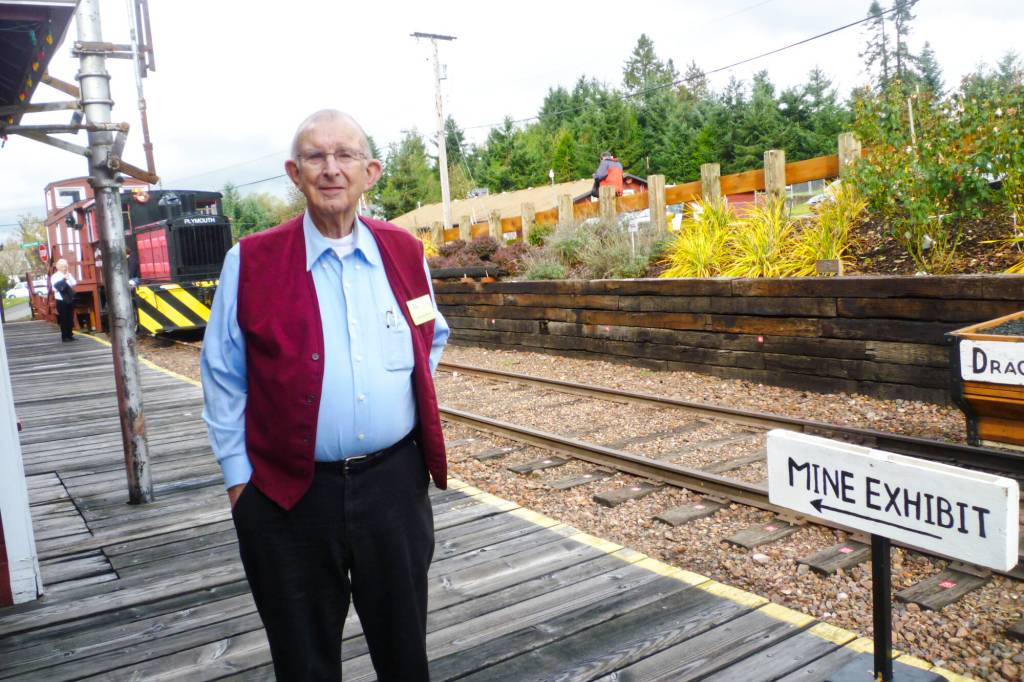
Malavotte said that if he wasn’t volunteering at the Black Diamond History Museum, that meant he was helping out someone else around town.
“[Howard and Dorothy] were always going to go see somebody, if they were sick or if they needed something,” she said. “They were just those kind of people.”
You can see other markers of Botts’ legacy around town today, as he was instrumental in the creation of The Coal Miners’ Honor Garden outside the history museum and the “Welcome to Black Diamond” coal carts on the highway through town. He was also a board member at the historical society and the Black Diamond Community Center.
“His influence runs through a lot of the aspects of what Black Diamond is,” Malavotte said.
“He did a lot of work. Had a lot of good ideas,” Watson said. “He will be missed.”
A service is scheduled for Aug. 16 at 2 p.m. at the Black Diamond Community Center.